

Slender False Brome
brachypodium sylvaticum
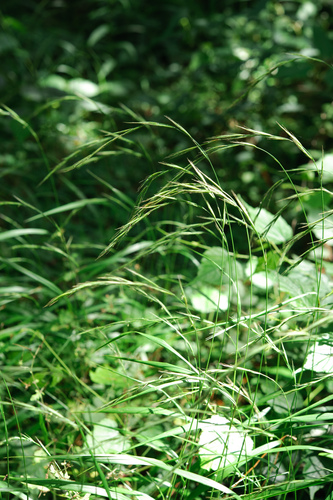
Slender False Brome (Brachypodium sylvaticum) is a versatile, perennial bunchgrass native to Europe, Asia, and North Africa. Characterized by its gracefully drooping, bright green leaves and delicate nodding flower spikes, this grass forms dense tufts that can carpet forest floors. While it plays a natural role in its native woodlands, it has earned a reputation as a highly aggressive invasive species in North America, particularly in the Pacific Northwest. Its ability to thrive in both deep, dark forest canopies and open, sunlit meadows allows it to rapidly outcompete native understory flora. This hardy plant adapts to a wide range of soil types and moisture levels, making it incredibly resilient. In regions where it is invasive, it disrupts local ecosystems by altering soil microbial communities and increasing the fuel load for wildfires. For nature enthusiasts, identifying Slender False Brome is an exercise in observing the subtle textures of forest undergrowth, highlighting the complex dynamics of plant migration and ecological balance.
Lebensraum: Typically found in shaded deciduous and coniferous forests, woodland edges, and moist meadows.
Slender False Brome is a clump-forming grass that grows between 50 to 150 centimeters tall. It is easily recognized by its lime-green to bright-green leaves, which are flat, relatively broad, and distinctly drooping. A key identifier is the presence of fine, conspicuous hairs along the leaf edges (margins) and on the leaf sheaths, giving the plant a fuzzy appearance. The flower spikes (spikelets) are pale green, unbranched, and nod gracefully on short stalks, blooming from mid-summer to autumn.
Kategorie
PflanzenSeltenheit
Common
Gefahr
1/5 · Sehr gering
Snaps
Mach den ersten Snap!
Because the plant remains green longer into the autumn and winter than native grasses, it can alter the wildfire dynamics of infested forests by creating a highly flammable thatch layer.
Despite being a grass, Slender False Brome is exceptionally shade-tolerant and can successfully dominate dark forest floors that are hostile to most other herbaceous plants.
Its scientific genus name, Brachypodium, is derived from the Greek words for 'short' and 'foot', referring to the very short stalks of its flower spikelets.
Unlike many grasses, it can photosynthesize and thrive in deep forest understories receiving less than ten percent full sunlight.
Its seeds possess small awns and hairs that readily cling to animal fur, clothing, and vehicles, allowing for rapid geographic dispersal.
Exudes chemical compounds through its root system that inhibit the germination and growth of neighboring native plant species.
As an autotrophic organism, it produces its own energy via photosynthesis using sunlight, carbon dioxide, water, and essential soil minerals.
Pararge aegeria
The caterpillars of the Speckled Wood butterfly feed on the leaves of this grass as a primary larval food source in Europe.
Pseudotsuga menziesii
In invaded North American forests, it forms thick carpets that outcompete and prevent the germination of native Douglas-fir seedlings.
Odocoileus hemionus
Mule deer occasionally graze on the foliage, although they generally prefer native grasses and broadleaf plants.
Für dieses Objekt sind noch keine Merkmal-Badges vergeben.
Noch keine Alternativnamen vorhanden.
Sammlungen für dieses Objekt erscheinen hier, wenn weitere Themen hinzugefügt werden.
Gefahr
1/5 · Sehr gering
Noch keine besonderen Sicherheitshinweise.
Der einfachste Weg, Slender False Brome zu bestimmen, ist die Verwendung der Naturführer-App Snappit.
50-150 cm
3-10 Jahre
As an autotrophic organism, it produces its own energy via photosynthesis using sunlight, carbon dioxide, water, and essential soil minerals.
Typically found in shaded deciduous and coniferous forests, woodland edges, and moist meadows.
Photosynthesis
Zoome hinein, um Cluster aufzulösen und zu sehen, wo dieses Objekt fotografiert wurde.
Neueste Snaps erscheinen hier, wenn neue Beobachtungen hinzukommen.









_001.jpg&width=800)