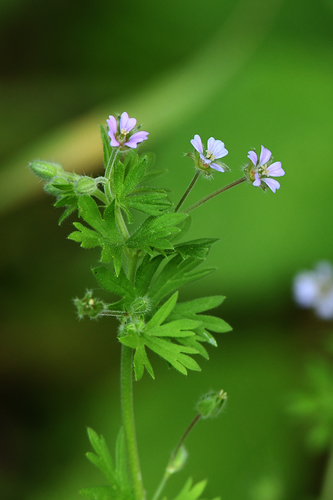


Small-Flowered Crane'S-Bill
geranium pusillum
The Small-Flowered Crane's-Bill (Geranium pusillum) is a charming, low-growing annual or biennial herb that belongs to the geranium family. Often overlooked due to its diminutive size, this plant thrives in disturbed soils, dry grasslands, and urban wastelands. Its delicate lavender-to-pink flowers offer a subtle burst of color amidst grassy patches, proving that beauty can be found in the smallest details of nature. Its common name, 'crane's-bill,' refers to the distinctive, beak-like fruit capsule that develops after pollination.
Lebensraum: Found in dry grasslands, cultivated fields, roadsides, and disturbed soils, often thriving in sandy or gravelly locations.
This species typically forms a sprawling mat or rises slightly up to 40 cm in height, featuring highly branched stems covered in soft, downward-pointing hairs. Its kidney-shaped leaves are deeply divided into 5 to 7 lobes, which are further split at the tips. The tiny flowers measure only 4 to 6 mm across, with five pale violet or pink petals that are notched at the ends. A key identifier is that its flowers have only five fertile stamens, and they are followed by an elongated, hairy, beak-like fruit capsule.
Kategorie
PflanzenSeltenheit
Common
Gefahr
1/5 · Sehr gering
Snaps
Mach den ersten Snap!
The botanical name 'Geranium' comes from the Greek word 'geranos,' meaning crane, referencing the shape of the seed pod.
The explosive seed dispersal mechanism can catapult seeds up to several meters away from the parent plant.
Unlike many other geraniums that have 10 fertile stamens, Geranium pusillum typically has only 5 fertile stamens, which is a key identification feature.
The beak-like fruit capsule dries and splits open with explosive force, flinging seeds several feet away from the parent plant to colonize new territory.
Soft, dense hairs covering the stems and leaves reduce airflow over the plant surface, conserving moisture in dry environments.
It can germinate rapidly in heavily disturbed, nutrient-poor soils where other plants struggle to establish.
As a photoautotroph, this plant generates its own energy from sunlight, water, and carbon dioxide through the process of photosynthesis.
Lasioglossum calceatum
Provides nectar and pollen to small wild bees during its blooming period.
Aphis fabae
Serves as a host plant and food source for sap-sucking insects.
Taraxacum officinale
Competes for light, space, and water in lawns and fields.
Für dieses Objekt sind noch keine Merkmal-Badges vergeben.
Noch keine Alternativnamen vorhanden.
Sammlungen für dieses Objekt erscheinen hier, wenn weitere Themen hinzugefügt werden.
Gefahr
1/5 · Sehr gering
Noch keine besonderen Sicherheitshinweise.
Der einfachste Weg, Small-Flowered Crane'S-Bill zu bestimmen, ist die Verwendung der Naturführer-App Snappit.
10-40 cm
1-2 Jahre
As a photoautotroph, this plant generates its own energy from sunlight, water, and carbon dioxide through the process of photosynthesis.
Found in dry grasslands, cultivated fields, roadsides, and disturbed soils, often thriving in sandy or gravelly locations.
Zoome hinein, um Cluster aufzulösen und zu sehen, wo dieses Objekt fotografiert wurde.
Neueste Snaps erscheinen hier, wenn neue Beobachtungen hinzukommen.
















