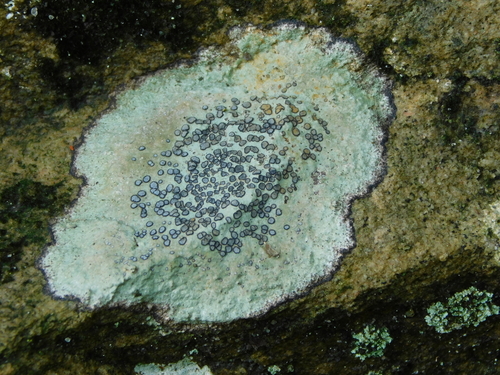


Smokey-Eyed Boulder Lichen
porpidia albocaerulescens
The Smokey-Eyed Boulder Lichen (Porpidia albocaerulescens) is a fascinating crustose lichen that paints a quiet, beautiful scene on non-calcareous boulders and damp rock outcrops in shaded woodlands. It represents an intricate symbiotic partnership between an ascomycete fungus and a microscopic green algal partner. Growing as a thin, tightly bound crust, this species slowly colonizes cold, acidic stones, contributing quietly to the breakdown of rock into rich, organic soil. What makes it a favorite among naturalists is the mesmerizing aesthetic of its fruiting bodies, which resemble tiny, frosted black discs. These structures have a ghostly, frosted appearance that has earned the lichen its highly evocative common name, making it a delightful find for sharp-eyed hikers.
Lebensraum: Found on shaded, acidic, non-calcareous rocks such as granite or sandstone in moist temperate forests.
This species forms a flat, paint-like thallus that adheres tightly to rock surfaces, colored in shades of pale gray, chalky white, or light bluish-gray. It is punctuated by small, flat, circular fruiting bodies (apothecia) that measure 0.5 to 2 millimeters in diameter. These black discs are covered with a characteristic waxy, pale blue-grey powder called pruina, which gives them a frosted or 'smokey' appearance set against a dark, raised outer rim.
Kategorie
PilzeSeltenheit
Common
Gefahr
1/5 · Sehr gering
Snaps
Mach den ersten Snap!
Because it absorbs all of its nutrients directly from the air and rain rather than soil, it acts as a highly sensitive bioindicator of local air quality.
The 'smokey eyes' are actually spore-producing structures covered in a microscopic layer of calcium oxalate crystals.
This lichen grows incredibly slowly, often expanding its outer diameter by only a fraction of a millimeter each year.
Secretes specialized lichen acids that slowly dissolve mineral bonds in hard stone, securing a permanent anchor and releasing locked nutrients.
Can undergo complete desiccation during dry spells, suspending metabolic activity until rainwater instantly revives its photosynthetic systems.
Uses a frosty, waxy mineral coating over its reproductive structures to reflect harmful ultraviolet radiation while maintaining optimal temperature.
As a lichenized fungus, it obtains organic carbon from the photosynthetic processes of its internal green algae partner, while absorbing water and atmospheric minerals directly from its environment.
Trebouxia gelatinosa
Provides essential sugars to the fungal host via photosynthesis in exchange for structural protection, water retention, and mineral absorption.
Deroceras reticulatum
Feeds directly on the lichen thallus and apothecia, utilizing the lichen as a reliable food source in damp woodland habitats.
Für dieses Objekt sind noch keine Merkmal-Badges vergeben.
Noch keine Alternativnamen vorhanden.
Sammlungen für dieses Objekt erscheinen hier, wenn weitere Themen hinzugefügt werden.
Gefahr
1/5 · Sehr gering
Noch keine besonderen Sicherheitshinweise.
Der einfachste Weg, Smokey-Eyed Boulder Lichen zu bestimmen, ist die Verwendung der Naturführer-App Snappit.
2-15 cm
10-100 Jahre
As a lichenized fungus, it obtains organic carbon from the photosynthetic processes of its internal green algae partner, while absorbing water and atmospheric minerals directly from its environment.
Found on shaded, acidic, non-calcareous rocks such as granite or sandstone in moist temperate forests.
Zoome hinein, um Cluster aufzulösen und zu sehen, wo dieses Objekt fotografiert wurde.
Neueste Snaps erscheinen hier, wenn neue Beobachtungen hinzukommen.

New York, US
Hier kann man sehen Grünlicher Wassermolch, Turkey-Tail und Trembling Crust.
Führer anzeigen →

Connecticut, US
Hier kann man sehen Geflecktes Wintergrün und Amerikanisches Wintergrün.
Führer anzeigen →

Connecticut, US
Hier kann man sehen Geflecktes Wintergrün und Amerikanisches Wintergrün.
Führer anzeigen →