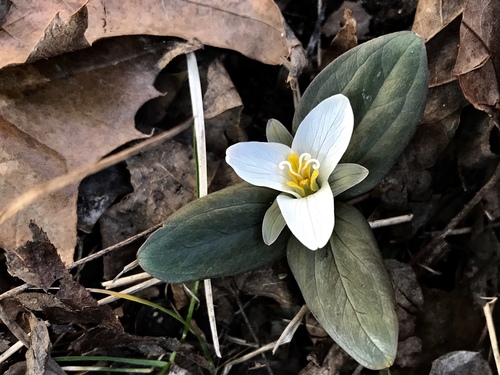


Snow Trillium
trillium nivale
The Snow Trillium is a true herald of spring, renowned for its remarkable ability to bloom while snow still blankets the forest floor. As the smallest of the North American trilliums, this resilient perennial wildflower emerges from underground rhizomes in late winter to early spring, taking advantage of the fleeting sunlight before the forest canopy closes overhead. It is a prized find for native plant enthusiasts and hikers who brave the cold early-season trails. This delicate plant plays a vital role in early spring forest ecosystems, offering some of the very first nectar sources to emerging queen bumblebees and other early pollinators. Its presence is often an indicator of a healthy, undisturbed mature forest community.
Lebensraum: Typically found in moist, alkaline woods, often on steep, rocky limestone slopes or ledges.
This diminutive wildflower features a classic three-part symmetry, growing only 5 to 15 centimeters tall. It produces a single whorl of three bluish-green, ovate leaves and a single, pristine white flower with three spreading petals, three green sepals, and six yellow anthers. The petals are notably small, usually measuring 1 to 2 centimeters in length, and sometimes have slightly wavy margins.
Kategorie
PflanzenSeltenheit
Common
Gefahr
1/5 · Sehr gering
Snaps
Mach den ersten Snap!
Because it blooms so early, it frequently gets buried under late-season snowstorms, but its cold-resistant tissues prevent it from freezing or suffering damage.
It is the smallest of all trillium species native to eastern North America, often standing no taller than a human finger.
The seeds have lipid-rich appendages called elaiosomes that attract ants, which carry the seeds back to their underground nests in a process called myrmecochory.
Blooms exceptionally early in the spring, often pushing directly through snow cover to capture sunlight before the forest canopy develops.
Utilizes ants to disperse seeds by offering a fatty, nutritious appendage called an elaiosome that ants carry back to their nests.
Features specialized cell sap concentration that prevents freezing damage during harsh late-winter frosts.
As a photosynthetic plant, the Snow Trillium generates its own energy from sunlight, water, and carbon dioxide, while absorbing essential minerals from alkaline forest soils.
Aphaenogaster rudis
Ants disperse the seeds by carrying them to their nests to feed on the nutrient-rich elaiosomes attached to the seeds.
Odocoileus virginianus
White-tailed Deer occasionally browse the foliage, which can severely impact the plant's survival and reproductive ability.
Bombus bimaculatus
Emerging bumblebee queens visit the early-blooming flowers to gather nectar and pollen, aiding in pollination.
Für dieses Objekt sind noch keine Merkmal-Badges vergeben.
Noch keine Alternativnamen vorhanden.
Sammlungen für dieses Objekt erscheinen hier, wenn weitere Themen hinzugefügt werden.
Gefahr
1/5 · Sehr gering
Noch keine besonderen Sicherheitshinweise.
Der einfachste Weg, Snow Trillium zu bestimmen, ist die Verwendung der Naturführer-App Snappit.
5-15 cm
10-30 Jahre
As a photosynthetic plant, the Snow Trillium generates its own energy from sunlight, water, and carbon dioxide, while absorbing essential minerals from alkaline forest soils.
Typically found in moist, alkaline woods, often on steep, rocky limestone slopes or ledges.
Photosynthesis
Zoome hinein, um Cluster aufzulösen und zu sehen, wo dieses Objekt fotografiert wurde.
Neueste Snaps erscheinen hier, wenn neue Beobachtungen hinzukommen.

West Virginia, US
Hier kann man sehen Gefleckte Laternentröger, Götterbaum und Wanderdrossel.
Führer anzeigen →

Illinois, US
Hier kann man sehen Rotrücken-Salamander und Blanchard-Cricketfrosch.
Führer anzeigen →

Illinois, US
Hier kann man sehen Spring Blue-Eyed Mary und Holländerhosenblume.
Führer anzeigen →



_(8592459332).jpg&width=800)











