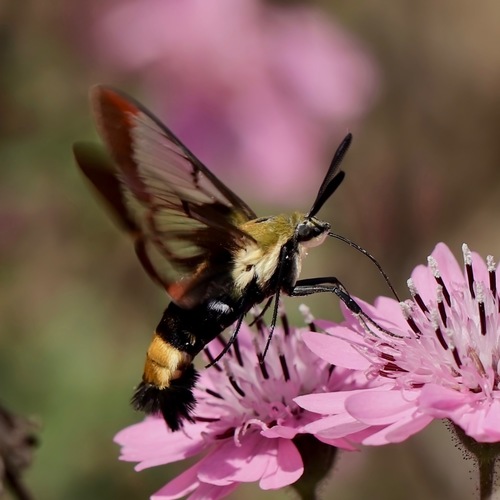


Snowberry Clearwing
hemaris diffinis
The Snowberry Clearwing is a fascinating diurnal moth that routinely fools casual observers into thinking they have spotted a bumblebee. Belonging to the sphinx moth family, this remarkable insect is a master of mimicry, boasting a fuzzy yellow and black body that brilliantly deters potential predators. As they dart from flower to flower, their rapid wingbeats and hovering feeding style often draw comparisons to tiny hummingbirds. Beyond its clever disguise, the Snowberry Clearwing is a vibrant participant in North American ecosystems. They are vital pollinators, visiting a wide variety of blooming plants during the warm daylight hours. Their distinctive appearance and energetic daytime activity make them a favorite among garden enthusiasts and nature spotters, offering a perfect example of nature's ingenious evolutionary adaptations.
Lebensraum: Typically found in sunny meadows, woodland edges, suburban gardens, and open fields where their host plants and nectar sources are abundant.
The Snowberry Clearwing features a stout, fuzzy body with striking yellow and black banding, closely resembling a bumblebee. Upon emerging from the pupa, their wings are covered in dark scales, but these shed during their very first flight, leaving behind largely transparent wings with dark reddish-brown to black borders and distinct dark veins. They possess a wingspan of roughly 3.5 to 5 centimeters. Look for their long, curled proboscis uncoiling to probe deep into flowers as they hover in mid-air.
Kategorie
InsektenSeltenheit
Common
Gefahr
1/5 · Sehr gering
Snaps
Mach den ersten Snap!
Because they fly during the day and hover while feeding, many people mistake them for baby hummingbirds.
Despite their name, 'clearwings' actually hatch with fully scaled wings; the scales simply fall off in the wind during their first flight.
They overwinter underground in the pupa stage, wrapped in a dark brown cocoon spun among leaf litter.
When threatened, the caterpillars of this moth will thrash back and forth violently or drop to the ground to escape predators.
The moth mimics the visual appearance, buzzing sound, and fuzzy texture of a bumblebee, deterring predators that associate this pattern with a painful sting.
Like hummingbirds, they can hover perfectly still in mid-air while extending their long proboscis to drink nectar from deep-throated flowers.
Their wings are fully scaled upon hatching, but they are specially adapted to shed most of these scales during their maiden flight to achieve a transparent appearance.
As larvae, they consume the foliage of specific host plants, while adults exclusively drink nectar from a variety of flowering plants.
Altersunterschiede: Caterpillars are foliage chewers that feed on host plants like snowberry and honeysuckle, whereas mature adults are flying pollinators that consume only liquid nectar.
Symphoricarpos albus
Primary larval host plant
Syringa vulgaris
Source of nectar for adults, aiding in pollination
Turdus migratorius
Preys on the adult moths or plump caterpillars
Für dieses Objekt sind noch keine Merkmal-Badges vergeben.
Noch keine Alternativnamen vorhanden.
Sammlungen für dieses Objekt erscheinen hier, wenn weitere Themen hinzugefügt werden.
Gefahr
1/5 · Sehr gering
Noch keine besonderen Sicherheitshinweise.
Der einfachste Weg, Snowberry Clearwing zu bestimmen, ist die Verwendung der Naturführer-App Snappit.
2-4 cm
3-5 cm
0.001-0.003 kg
0-1 Jahre
19 km/h
As larvae, they consume the foliage of specific host plants, while adults exclusively drink nectar from a variety of flowering plants.
Typically found in sunny meadows, woodland edges, suburban gardens, and open fields where their host plants and nectar sources are abundant.
Zoome hinein, um Cluster aufzulösen und zu sehen, wo dieses Objekt fotografiert wurde.
Neueste Snaps erscheinen hier, wenn neue Beobachtungen hinzukommen.

Oklahoma, US
Hier kann man sehen Westliche Rattenschlange und Spotted Chorus Frog.
Führer anzeigen →

Connecticut, US
Hier kann man sehen Schwammspinner und östlicher Zeltspinner.
Führer anzeigen →












