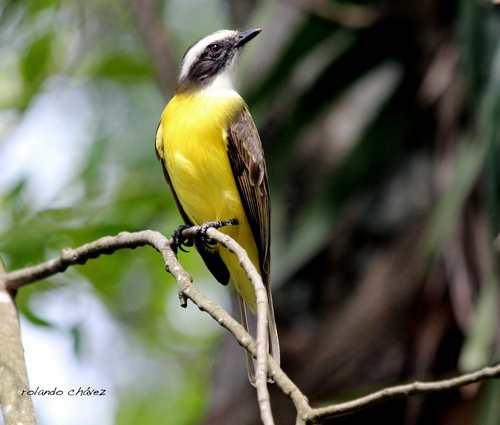


Social Flycatcher
myiozetetes similis
The Social Flycatcher is a vibrant, highly active passerine bird native to the Americas, ranging from northwestern Mexico down to northeastern Argentina. Known for its noisy and social disposition, this member of the tyrant flycatcher family is often seen in pairs or small family groups, constantly communicating with a range of sharp, piping calls. They are highly adaptable birds, frequently seen perched on exposed branches, telephone wires, or fence posts near water sources or open areas. What makes the Social Flycatcher particularly captivating is its bold personality and aggressive defense of its nesting territory. Despite its relatively small size, it will not hesitate to mob much larger birds, such as hawks or toucans, that venture too close to its bulky, domed nest. Their conspicuous nature, cheerful appearance, and tolerance of human presence make them a beloved sight for birdwatchers across their extensive neotropical range.
Lebensraum: Found in semi-open habitats, forest edges, agricultural areas, and gardens, almost always in close proximity to water.
The Social Flycatcher is a medium-sized flycatcher, measuring about 16 to 18 cm in length, with a bright olive-brown back and striking, vivid yellow underparts. Its head pattern is highly distinctive, featuring a dark grey-black crown with a concealed crown patch of orange or red, bordered by a prominent white supercilium and a dark eye stripe. It closely resembles the larger Great Kiskadee, but can be distinguished by its much smaller bill, smaller overall size, and the absence of rufous coloration on its wings and tail.
Kategorie
VögelSeltenheit
Common
Gefahr
1/5 · Sehr gering
Snaps
Mach den ersten Snap!
Despite their small size, Social Flycatchers are incredibly brave and will fearlessly attack large raptors that approach their nests.
Their scientific name Myiozetetes translates roughly to 'fly-seeker', highlighting their expert insect-hunting lifestyle.
They are known to feed on tadpoles and tiny fish swimming near the surface of the water, a rare behavior for typical tyrant flycatchers.
They build bulky, spherical nests with a side entrance, often constructing them near wasp nests for added protection from predators.
They are highly skilled at spotting flying insects from an exposed perch and launching brief, agile aerial pursuits to snap them out of the air.
They work together in family groups to aggressively harass and drive away potential nest predators, regardless of the predator's size.
They possess a rich repertoire of loud, high-pitched calls used to defend territory and warn family members of incoming threats.
Primarily feeds on flying insects caught mid-air, but also consumes a significant amount of small fruits, berries, and occasionally small tadpoles.
Altersunterschiede: Chicks are fed almost exclusively high-protein insects by parents before transitioning to include fruits as they mature.
Pitangus sulphuratus
Competes for food resources, nesting sites, and territory in overlapping habitats.
Ficus aurea
Provides food through its abundant fruiting cycles, which the flycatcher relies on heavily.
Philornis pici
Larvae parasitize the nestlings of the flycatcher, feeding on their blood and tissue.
Für dieses Objekt sind noch keine Merkmal-Badges vergeben.
Noch keine Alternativnamen vorhanden.
Sammlungen für dieses Objekt erscheinen hier, wenn weitere Themen hinzugefügt werden.
Gefahr
1/5 · Sehr gering
Noch keine besonderen Sicherheitshinweise.
Der einfachste Weg, Social Flycatcher zu bestimmen, ist die Verwendung der Naturführer-App Snappit.
16-18 cm
26-30 cm
0.024-0.03 kg
3-6 Jahre
40 km/h
Primarily feeds on flying insects caught mid-air, but also consumes a significant amount of small fruits, berries, and occasionally small tadpoles.
Found in semi-open habitats, forest edges, agricultural areas, and gardens, almost always in close proximity to water.
Zoome hinein, um Cluster aufzulösen und zu sehen, wo dieses Objekt fotografiert wurde.
Neueste Snaps erscheinen hier, wenn neue Beobachtungen hinzukommen.









.jpg&width=800)







.jpg&width=800)
