

Sonchus Hierrensis
sonchus hierrensis
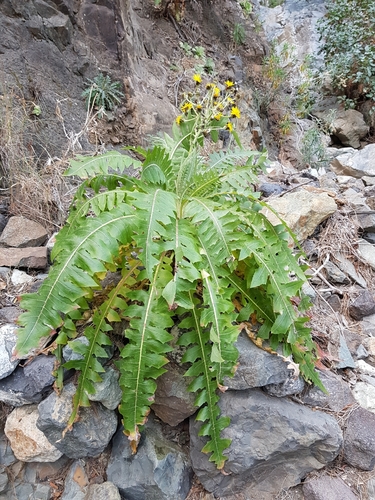
Sonchus hierrensis, commonly known as the El Hierro sow thistle, is an extraordinary woody shrub endemic to the Canary Islands of El Hierro and La Palma. Unlike its common, weedy herbaceous relatives found across the globe, this species is a prime example of insular woodiness, a phenomenon where herbaceous lineages evolve into robust, shrubby forms in isolated island ecosystems. Growing up to two meters high, it features large, dramatic rosettes of deeply lobed leaves at the ends of thick branches, crowned by clusters of bright yellow flowers. This botanical marvel plays a vital role in its local ecosystem, providing abundant nectar for endemic pollinators and serving as a striking symbol of the unique evolutionary history of the Macaronesian archipelago.
Lebensraum: Found on steep rocky cliffs, volcanic slopes, and edges of laurel forests within the humid zones of El Hierro and La Palma.
This robust, woody shrub typically grows between 100 and 200 centimeters tall, characterized by thick, greyish-brown branching stems that terminate in dense rosettes of large, deeply lobed (pinnatisect) leaves. The leaves are a vibrant green to blue-green color, up to 40 centimeters long, with sharply pointed but relatively soft teeth along the margins. During its blooming season, it produces a spectacular, branching inflorescence packed with numerous bright yellow flower heads, each resembling a large daisy-like dandelion bloom about 2 to 3 centimeters in diameter.
Kategorie
PflanzenSeltenheit
Common
Gefahr
1/5 · Sehr gering
Snaps
Mach den ersten Snap!
Despite looking like a woody bush or small tree, it is actually a close relative of the common garden dandelion.
Its scientific name 'hierrensis' directly refers to the island of El Hierro, one of the primary locations where it evolved and thrives.
This species is a classic textbook example of 'island gigantism,' where herbaceous plants grow into large woody structures over evolutionary time.
Evolved a sturdy, woody habit from herbaceous ancestors to better compete for sunlight and survive in temperate island climates.
Produces lightweight seeds equipped with a feathery pappus, allowing wind currents to transport them across steep volcanic ravines.
Features semi-succulent stems that store moisture, helping the plant survive dry periods on exposed rocky cliffs.
As a photoautotrophic plant, it produces its own food using sunlight, water, carbon dioxide, and essential soil nutrients through photosynthesis.
Bombus canariensis
Pollinated by endemic bumblebees searching for nectar and pollen in the highland zones.
Gallotia simonyi
The leaves and young shoots are occasionally grazed by endangered local lizards.
Für dieses Objekt sind noch keine Merkmal-Badges vergeben.
Noch keine Alternativnamen vorhanden.
Sammlungen für dieses Objekt erscheinen hier, wenn weitere Themen hinzugefügt werden.
Gefahr
1/5 · Sehr gering
Noch keine besonderen Sicherheitshinweise.
Der einfachste Weg, Sonchus Hierrensis zu bestimmen, ist die Verwendung der Naturführer-App Snappit.
100-200 cm
5-15 Jahre
As a photoautotrophic plant, it produces its own food using sunlight, water, carbon dioxide, and essential soil nutrients through photosynthesis.
Found on steep rocky cliffs, volcanic slopes, and edges of laurel forests within the humid zones of El Hierro and La Palma.
14-28 Tage
Zoome hinein, um Cluster aufzulösen und zu sehen, wo dieses Objekt fotografiert wurde.
Neueste Snaps erscheinen hier, wenn neue Beobachtungen hinzukommen.