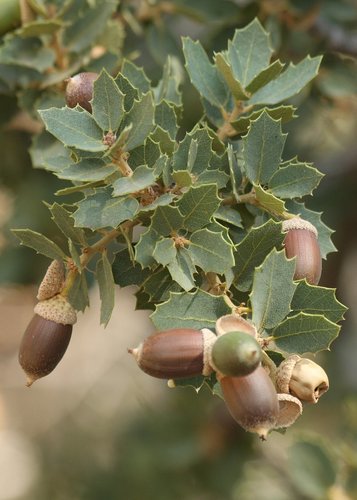


Sonoran Scrub Oak
quercus turbinella
The Sonoran Scrub Oak (Quercus turbinella) is a resilient, evergreen shrub-like oak that dominates the arid, rugged landscapes of the southwestern United States and northern Mexico. Characterized by its scrubby, multi-trunked growth form, this hardy oak is perfectly adapted to survive extreme heat, drought, and wildfires. It acts as an ecological anchor in chaparral, pinyon-juniper woodlands, and desert scrub zones, offering critical shade and food to local wildlife. Despite its modest size compared to towering forest giants, this tough oak is long-lived and forms deep root networks that hold dry desert soils together, earning its place as an indispensable player in arid ecosystems.
Lebensraum: Found in arid chaparral, desert grasslands, and pinyon-juniper woodlands, typically on dry, rocky slopes and canyon walls.
Typically growing as a dense, sprawling shrub between 1 to 5 meters tall, this species is easily identified by its small, holly-like evergreen leaves. The leaves are leathery, dusty blue-green to grayish-green in color, measuring about 1 to 3 centimeters long with sharp, spine-tipped teeth along the margins. The undersides of the leaves often possess a yellowish, fuzzy texture. In late summer and fall, it produces slender, light brown acorns with shallow, scaly caps that sit singly or in pairs along the branches, providing an unmistakable diagnostic feature of this miniature oak.
Kategorie
PflanzenSeltenheit
Common
Gefahr
1/5 · Sehr gering
Snaps
Mach den ersten Snap!
Despite being called a shrub, the Sonoran Scrub Oak belongs to the same genus as the towering majestic English and White Oaks.
Individual stands of these oaks can form massive clonal colonies through underground root systems, meaning an entire hillside of shrubs might be a single genetic organism.
Its acorns were historically ground into meal and leached of bitter tannins by Indigenous desert peoples, including the Apache and Yavapai, to make a nutritious porridge.
Following a wildfire, this oak can rapidly regenerate from its underground root crown (lignotuber), allowing it to colonize burned landscapes.
Its thick, leathery, spine-edged leaves prevent excessive water loss through transpiration and deter herbivores from grazing.
The plant develops extensive root systems that reach deep water tables, enabling survival during prolonged desert droughts.
As a photoautotroph, the Sonoran Scrub Oak synthesizes its own sugars using sunlight, water, and carbon dioxide through photosynthesis.
Melanerpes formicivorus
Harvests and caches the acorns as a major winter food source, inadvertently planting new trees.
Odocoileus hemionus
Feeds on the evergreen foliage and twigs, especially during winter when other forage is scarce.
Disholcaspis plumbella
Lays eggs in the oak's twigs, inducing the tree to form protective galls that house the wasp larvae.
Für dieses Objekt sind noch keine Merkmal-Badges vergeben.
Noch keine Alternativnamen vorhanden.
Sammlungen für dieses Objekt erscheinen hier, wenn weitere Themen hinzugefügt werden.
Gefahr
1/5 · Sehr gering
Noch keine besonderen Sicherheitshinweise.
Der einfachste Weg, Sonoran Scrub Oak zu bestimmen, ist die Verwendung der Naturführer-App Snappit.
100-500 cm
100-300 Jahre
As a photoautotroph, the Sonoran Scrub Oak synthesizes its own sugars using sunlight, water, and carbon dioxide through photosynthesis.
Found in arid chaparral, desert grasslands, and pinyon-juniper woodlands, typically on dry, rocky slopes and canyon walls.
Zoome hinein, um Cluster aufzulösen und zu sehen, wo dieses Objekt fotografiert wurde.
Neueste Snaps erscheinen hier, wenn neue Beobachtungen hinzukommen.

Nevada, US
Hier kann man sehen Engelmann's Hedgehog Cactus.
Führer anzeigen →

Utah, US
Hier kann man sehen Felsenhörchen, Maultierhirsch und Plateau-Zauneidechse.
Führer anzeigen →








.jpg&width=800)