

Sourwood
oxydendrum arboreum
Sourwood, also known as the sorrel tree, is a deciduous understory tree native to the eastern United States, particularly renowned in the Appalachian region. Celebrated for its striking late-summer blooms and brilliant autumn foliage, it is a standout species in deciduous forests, where it rarely exceeds moderate heights. It is highly prized by beekeepers, as its delicate white bell-shaped flowers yield an incredibly rich, light-colored honey with a distinctively sharp, sweet flavor. Its sour-tasting leaves, which contain oxalic acid, give the tree both its common and scientific names.
Lebensraum: Found in well-drained, acidic soils of upland deciduous forests, ridges, and slopes, often growing alongside oaks and pines.
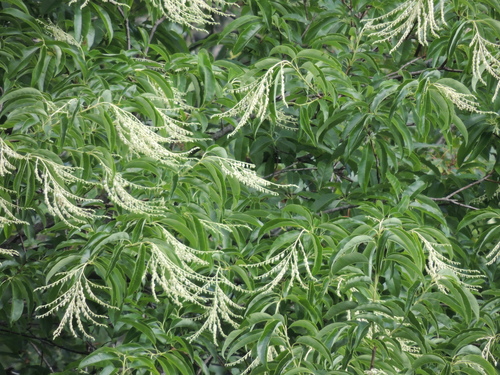
Sourwood typically grows 9 to 15 meters tall, featuring a slender trunk and a rounded canopy. Its bark is thick, deeply furrowed, and gray-brown, resembling alligator skin on older specimens. The leaves are oblong, finely serrated, and a glossy green during spring and summer, turning a breathtaking brilliant crimson to purple in early autumn. In mid-to-late summer, the tree produces drooping panicles of small, white, urn-shaped flowers that resemble lilies-of-the-valley, which eventually dry into persistent woody seed capsules.
Kategorie
PflanzenSeltenheit
Common
Gefahr
1/5 · Sehr gering
Snaps
Mach den ersten Snap!
Mountain hikers sometimes chew on the leaves to alleviate thirst, as the sour taste stimulates saliva production.
Sourwood honey is highly prized and rare because the trees bloom for only a short period in mid-summer, requiring beekeepers to time their hive placements perfectly.
The common name 'Sourwood' and scientific name 'Oxydendrum' (sour wood in Greek) both refer to the acidic, sour taste of the leaves.
The leaves contain oxalic acid, giving them a sour taste that deters many generalist herbivores and insect pests.
Unlike most forest trees, it blooms in mid-to-late summer, avoiding competition for pollinators and providing a vital late-season nectar source.
Rapidly produces anthocyanin pigments in autumn, protecting its leaves from light damage as it resorbs nutrients before shedding.
As a photosynthetic plant, sourwood produces its own energy using sunlight, carbon dioxide, water, and essential nutrients absorbed from acidic soil.
Apis mellifera
Bees pollinate the flowers while harvesting nectar to produce famous sourwood honey.
Hyalophora cecropia
The caterpillars of this giant silk moth feed on the leaves of the sourwood.
Odocoileus virginianus
Deer browse on the twigs and leaves of sourwood, especially during the winter.
Für dieses Objekt sind noch keine Merkmal-Badges vergeben.
Noch keine Alternativnamen vorhanden.
Sammlungen für dieses Objekt erscheinen hier, wenn weitere Themen hinzugefügt werden.
Gefahr
1/5 · Sehr gering
Noch keine besonderen Sicherheitshinweise.
Der einfachste Weg, Sourwood zu bestimmen, ist die Verwendung der Naturführer-App Snappit.
900-1800 cm
100-200 Jahre
As a photosynthetic plant, sourwood produces its own energy using sunlight, carbon dioxide, water, and essential nutrients absorbed from acidic soil.
Found in well-drained, acidic soils of upland deciduous forests, ridges, and slopes, often growing alongside oaks and pines.
Photosynthesis
Zoome hinein, um Cluster aufzulösen und zu sehen, wo dieses Objekt fotografiert wurde.
Neueste Snaps erscheinen hier, wenn neue Beobachtungen hinzukommen.

















