

Southern Longhorn Moth
adela caeruleella
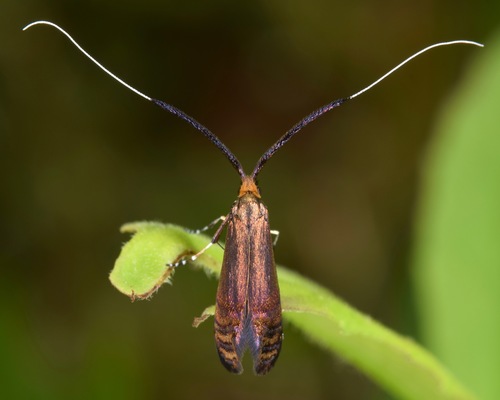
The Southern Longhorn Moth (Adela caeruleella) is an enchanting micromoth celebrated for its remarkable, exaggerated antennae and vibrant coloration. Native to the deciduous forests of North America, this species brings a touch of miniature spectacle to the spring woods. While females possess antennae of a relatively modest length, the males sport incredibly long, thread-like feelers that trail behind them like elegant silver whips as they fly. This species is part of the fairy moth family, Adelidae, known for their metallic wings and diurnal habits. Witnessing a group of these tiny insects dancing in a sun shaft on a warm afternoon is an unforgettable experience for any nature enthusiast. Despite their small size, their unique biology, intricate courtship displays, and ecological role as decomposers in their larval stage make them a fascinating subject of study for entomologists and casual observers alike.
Lebensraum: Found in deciduous forests, mixed woodlands, and damp forest edges where leaf litter is abundant.
This small moth has a wingspan of roughly 1 to 2 centimeters. Its most striking feature is its long, thread-like antennae, which in males can reach up to three times the length of the body, while female antennae are much shorter and thickened at the base. The forewings are lanceolate and display a shimmering, metallic dark purple, violet, or bronze-green sheen, depending on how light hits the structural scales. The hindwings are typically a darker, more muted grey-brown with less iridescence. The body is slender, covered in dark, hair-like scales, and the legs are fine and pale, often blending into the foliage.
Kategorie
InsektenSeltenheit
Common
Gefahr
1/5 · Sehr gering
Snaps
Mach den ersten Snap!
Male Southern Longhorn Moths possess antennae that can be up to three times their total body length.
Their wings utilize structural coloration, shimmering with purplish and bronzed metallic hues rather than relying solely on chemical pigments.
Unlike many moths that are strictly nocturnal, these moths are highly active during the day and can often be seen dancing in bright forest sunbeams.
Males possess extraordinarily long antennae that aid in detecting female pheromones across dense woodland foliage.
Their wings use microscopic structural scales to reflect light in brilliant metallic hues, deterring potential predators.
Males gather in shafts of sunlight filtering through the forest canopy, performing synchronized hovering flights to attract mates.
Adults primarily feed on nectar from spring wildflowers, while the larvae are detritivores feeding on leaf litter.
Altersunterschiede: Larvae live on the forest floor feeding on decaying leaf matter, whereas adults transition to a diet of flower nectar once metamorphosed.
Quercus alba
Larvae feed on the fallen, decaying leaves of this oak tree.
Araneus diadematus
This spider builds webs in the lower shrub layers where it catches and consumes adult moths.
Adela purpurea
They compete with other fairy moths for mating swarms and nectar resources.
Für dieses Objekt sind noch keine Merkmal-Badges vergeben.
Noch keine Alternativnamen vorhanden.
Sammlungen für dieses Objekt erscheinen hier, wenn weitere Themen hinzugefügt werden.
Gefahr
1/5 · Sehr gering
Noch keine besonderen Sicherheitshinweise.
Der einfachste Weg, Southern Longhorn Moth zu bestimmen, ist die Verwendung der Naturführer-App Snappit.
1 cm
1-2 cm
0.00001-0.00003 kg
1 Jahre
5 km/h
Adults primarily feed on nectar from spring wildflowers, while the larvae are detritivores feeding on leaf litter.
Found in deciduous forests, mixed woodlands, and damp forest edges where leaf litter is abundant.
Zoome hinein, um Cluster aufzulösen und zu sehen, wo dieses Objekt fotografiert wurde.
Neueste Snaps erscheinen hier, wenn neue Beobachtungen hinzukommen.