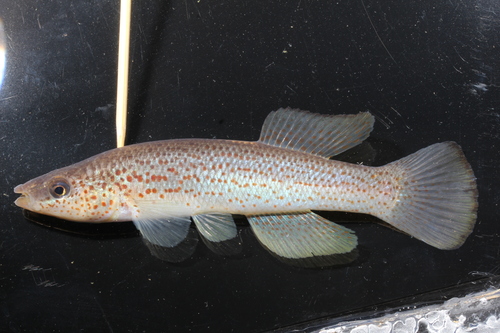


Southern Studfish
fundulus stellifer
The Southern Studfish (Fundulus stellifer) is a striking and vibrant freshwater killifish native to the southeastern United States. Part of the topminnow family, this species is well-known among regional ichthyologists for the breathtaking breeding colors displayed by dominant males. During the spring and summer, these males transform, flashing brilliant shades of iridescent blue and green adorned with vivid orange and red spots to attract mates and defend their territories. Beyond their beauty, Southern Studfish play an essential role in their aquatic ecosystems. They are active foragers that help control aquatic insect populations while simultaneously serving as a vital food source for larger predatory fish and wading birds. Found primarily in clear, slow-moving pools and backwaters of sandy or rocky streams, these resilient little fish offer a delightful surprise for patient nature spotters exploring the rich biodiversity of Appalachian and Gulf Coastal river drainages.
Lebensraum: Typically found in clear, slow-moving pools, backwaters, and margins of small to medium-sized rivers and streams with sandy or gravelly substrates.
The Southern Studfish is a robust, moderately sized killifish reaching up to 12 centimeters in length. It features a broad, slightly flattened head, an upturned mouth adapted for surface feeding, and a rounded caudal fin. Non-breeding individuals and females generally sport olive-brown to pale olive backs with silvery sides and faint vertical bars. However, breeding males are spectacular, exhibiting iridescent powder-blue to greenish flanks heavily speckled with bright red or orange spots. These breeding males also develop striking orange to reddish margins on their dorsal, anal, and caudal fins, making them easily distinguishable in clear, shallow waters.
Kategorie
FischeSeltenheit
Common
Gefahr
1/5 · Sehr gering
Snaps
Mach den ersten Snap!
During spawning, the male uses his highly colored fins to perform intricate courtship displays over gravel beds to entice passing females.
Like many topminnows, the Southern Studfish has a flattened head and an upturned mouth, making it perfectly evolved to gulp air or snatch bugs directly from the water's surface.
The common name 'Studfish' likely comes from the vibrant, showy appearance and aggressive territoriality of the breeding males, akin to a 'stud' horse.
They are endemic only to a small portion of the southeastern United States, making them a special find for regional biodiversity enthusiasts.
Its specialized, upturned mouth allows it to efficiently capture aquatic insects and mosquito larvae directly from the water's surface.
During the breeding season, males undergo a dramatic color change, displaying bright blue and orange hues to establish dominance and attract females.
Males fiercely defend small patches of sandy or gravel substrate during the spawning season, aggressively chasing away rival males and other small fish.
The Southern Studfish is an opportunistic omnivore that primarily feeds on aquatic and terrestrial insects, alongside small crustaceans and occasional plant matter.
Altersunterschiede: Juveniles consume smaller zooplankton and micro-invertebrates before transitioning to larger aquatic insects as they reach adulthood.
Anopheles quadrimaculatus
Preys on mosquito larvae and other water-borne insects.
Micropterus salmoides
Eaten by large predatory freshwater fish.
Ardea herodias
Eaten by wading birds hunting in the shallows.
Für dieses Objekt sind noch keine Merkmal-Badges vergeben.
Noch keine Alternativnamen vorhanden.
Sammlungen für dieses Objekt erscheinen hier, wenn weitere Themen hinzugefügt werden.
Gefahr
1/5 · Sehr gering
Noch keine besonderen Sicherheitshinweise.
Der einfachste Weg, Southern Studfish zu bestimmen, ist die Verwendung der Naturführer-App Snappit.
7-12 cm
0.005-0.02 kg
2-4 Jahre
The Southern Studfish is an opportunistic omnivore that primarily feeds on aquatic and terrestrial insects, alongside small crustaceans and occasional plant matter.
Typically found in clear, slow-moving pools, backwaters, and margins of small to medium-sized rivers and streams with sandy or gravelly substrates.
Foraging
50-200
Zoome hinein, um Cluster aufzulösen und zu sehen, wo dieses Objekt fotografiert wurde.
Neueste Snaps erscheinen hier, wenn neue Beobachtungen hinzukommen.

Alabama, US
Hier kann man sehen Höhlensalamander, Rosa Frauenschuh und Manitou Cavesnail.
Führer anzeigen →

Alabama, US
Hier kann man sehen Höhlensalamander, Rosa Frauenschuh und Manitou Cavesnail.
Führer anzeigen →

Alabama, US
Hier kann man sehen Höhlensalamander, Rosa Frauenschuh und Manitou Cavesnail.
Führer anzeigen →

















.jpg&width=800)
