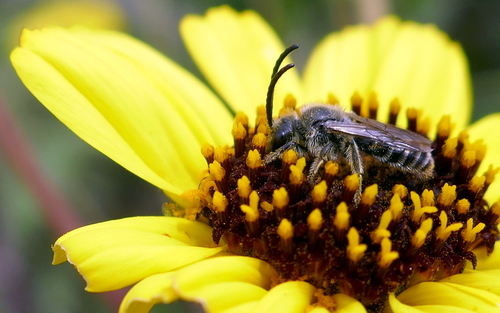


Southwestern Shortface
dufourea australis
The Southwestern Shortface (Dufourea australis) is a fascinating, solitary sweat bee native to the arid and semi-arid regions of the American Southwest. Unlike familiar social honeybees, these industrious insects live a solitary lifestyle, with each female independently excavating her own underground nest in sandy or well-drained soils. Belonging to a group known as short-faced bees, they play an essential role as pollinators in their delicate desert ecosystems. What makes the Southwestern Shortface particularly interesting is its oligolectic foraging behavior, meaning it specializes in gathering pollen from only a narrow range of native flowering plants. This tight evolutionary bond ensures the survival of specific local flora while providing the bees with the exact nutrition they need for their developing larvae. Spotting one of these small, fast-flying bees darting among desert blooms is a rewarding experience for any sharp-eyed nature enthusiast.
Lebensraum: Found primarily in arid scrublands, deserts, and semi-arid canyons of the American Southwest, nesting in well-drained, sandy soils.
The Southwestern Shortface is a relatively small bee, measuring roughly 5 to 8 millimeters in length. It gets its common name from the distinctively shortened clypeus (the lower face area), giving it a slightly stubby, broad-faced appearance when viewed head-on. Its body is primarily dark, often black or dark metallic brownish-black, with sparse, pale hairs covering the thorax and abdomen. Females are equipped with specialized scopal hairs on their hind legs to carry pollen, which often appears as bright yellow or orange masses when fully loaded. Their wings are translucent with distinct, dark venation, and they lack the bright, bold banding patterns seen in many other common bee species.
Kategorie
InsektenSeltenheit
Common
Gefahr
1/5 · Sehr gering
Snaps
Mach den ersten Snap!
Because they do not produce honey or live in large colonies, these solitary bees are incredibly docile and will almost never sting unless physically crushed.
Despite being called sweat bees, members of the Dufourea genus are generally not attracted to human sweat like some of their halictid relatives.
The Southwestern Shortface spends up to 11 months of its life cycle underground as a developing larva and pupa, emerging as an adult for only a few short weeks to mate and forage.
Their distinctively short faces are believed to be an evolutionary adaptation shaped by the specific morphology of the flowers they specialize in pollinating.
This bee specializes in collecting pollen from a very narrow range of host plants, creating a highly efficient, mutualistic pollination network.
Females possess specialized mandibles and legs that allow them to rapidly dig deep, multi-branched nesting tunnels in tough desert soils.
Adapted to the extreme heat of the Southwest, these bees can forage during peak daylight hours by regulating their body temperature through flight patterns and microhabitat selection.
Adults feed on floral nectar for energy, while females collect specific pollen to provision their underground larval cells.
Altersunterschiede: Larvae consume a solid mixture of pollen and nectar provisioned by the mother, while adults consume primarily liquid nectar.
Phacelia crenulata
Relies heavily on the pollen and nectar of this desert wildflower to provision its nest.
Misumena vatia
Ambush predators that hide in desert blooms to capture foraging bees.
Sphecodes arvensis
A cleptoparasitic bee that sneaks into the Southwestern Shortface's nest to lay its own eggs, which then consume the host's pollen provisions.
Für dieses Objekt sind noch keine Merkmal-Badges vergeben.
Noch keine Alternativnamen vorhanden.
Sammlungen für dieses Objekt erscheinen hier, wenn weitere Themen hinzugefügt werden.
Gefahr
1/5 · Sehr gering
Noch keine besonderen Sicherheitshinweise.
Der einfachste Weg, Southwestern Shortface zu bestimmen, ist die Verwendung der Naturführer-App Snappit.
1 cm
1-2 cm
0.00001-0.00003 kg
0-1 Jahre
Adults feed on floral nectar for energy, while females collect specific pollen to provision their underground larval cells.
Found primarily in arid scrublands, deserts, and semi-arid canyons of the American Southwest, nesting in well-drained, sandy soils.
Foraging
Zoome hinein, um Cluster aufzulösen und zu sehen, wo dieses Objekt fotografiert wurde.
Neueste Snaps erscheinen hier, wenn neue Beobachtungen hinzukommen.

California, US
Hier kann man sehen Peridot Sweat Bee und Westlicher Zaunleguan.
Führer anzeigen →

California, US
Hier kann man sehen Westmöwe, Westlicher Zaunleguan und Brauner Pelikan.
Führer anzeigen →













.jpg&width=800)




