

Spanish Dagger
yucca treculiana
The Spanish Dagger (Yucca treculiana) is a striking, tree-like succulent native to the arid brushlands of southern Texas and northeastern Mexico. Rising up to ten meters tall, this resilient plant stands as a sentinel of the desert, characterized by its stout trunk and a dramatic crown of stiff, bayonet-like leaves. For centuries, it has served as an ecological anchor in harsh, dry landscapes, providing vital shelter and food for local wildlife while anchoring the sandy soils with its robust root system. What makes the Spanish Dagger truly captivating is its spectacular flowering display and its ancient cultural significance. In the late winter and early spring, it produces a massive, towering stalk laden with hundreds of creamy-white, bell-shaped blossoms. Historically, indigenous peoples utilized almost every part of this plant, harvesting its tough leaf fibers for cordage, eating its nutritious flowers, and using its saponin-rich roots as soap, showcasing the profound link between human survival and desert botany.
Lebensraum: Thrives in arid and semi-arid environments, particularly brushlands, coastal dunes, and rocky limestone hillsides of southern Texas and northern Mexico.
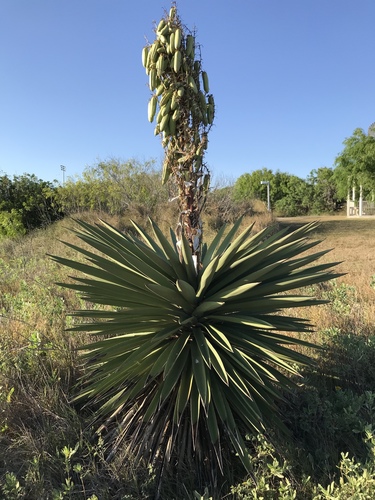
This plant is easily identified by its stout, often single or sparsely branched trunk topped with a dense rosette of rigid, dark green to blue-green leaves. Each leaf is concave, channel-shaped, and measures up to 100 centimeters long, tapering to a sharp, dark brown spine at the tip. In late winter, a massive, central flower spike emerges, bearing a dense, cone-shaped cluster of creamy-white, drooping, bell-shaped flowers that contrast sharply with the stiff, dangerous-looking leaves.
Kategorie
PflanzenSeltenheit
Common
Gefahr
1/5 · Sehr gering
Snaps
Mach den ersten Snap!
It shares an obligate mutualistic relationship with the Yucca Moth, meaning neither species can successfully reproduce without the presence of the other.
Native Americans harvested the tough, fibrous leaves of the Spanish Dagger to weave durable baskets, ropes, and sandals.
The roots contain saponins, natural soap-like compounds, which were traditionally crushed and used as a lathering shampoo.
The extremely sharp terminal spines and stiff margins of its leaves deter herbivores from damaging the plant's core.
Its thick trunk and fibrous leaves are highly adapted to store water, allowing it to survive prolonged periods of severe drought.
A thick, waxy cuticle covers the leaves, drastically reducing water loss from transpiration under the intense desert sun.
As a photoautotrophic plant, it produces its own organic compounds using sunlight, water, carbon dioxide, and essential minerals from the soil.
Tegeticula yuccasella
The yucca moth is the sole pollinator of the flowers, laying eggs inside the ovary where larvae feed on a portion of the developing seeds.
Odocoileus virginianus
White-tailed deer feed heavily on the succulent emerging flower stalks and buds in the early spring.
Für dieses Objekt sind noch keine Merkmal-Badges vergeben.
Noch keine Alternativnamen vorhanden.
Sammlungen für dieses Objekt erscheinen hier, wenn weitere Themen hinzugefügt werden.
Gefahr
1/5 · Sehr gering
Noch keine besonderen Sicherheitshinweise.
Der einfachste Weg, Spanish Dagger zu bestimmen, ist die Verwendung der Naturführer-App Snappit.
150+ cm
50+ Jahre
As a photoautotrophic plant, it produces its own organic compounds using sunlight, water, carbon dioxide, and essential minerals from the soil.
Thrives in arid and semi-arid environments, particularly brushlands, coastal dunes, and rocky limestone hillsides of southern Texas and northern Mexico.
Zoome hinein, um Cluster aufzulösen und zu sehen, wo dieses Objekt fotografiert wurde.
Neueste Snaps erscheinen hier, wenn neue Beobachtungen hinzukommen.