

Spanish Lavender
lavandula pedunculata
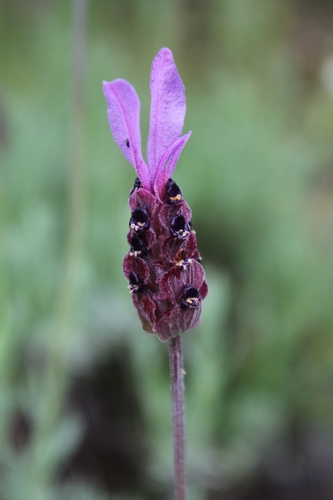
Spanish lavender is a striking evergreen shrub native to the Mediterranean region, celebrated for its unique, rabbit-ear-like bracts that crown each flower head. Unlike common English lavender, this species features dense, egg-shaped flower spikes topped with large, showy purple bracts that flutter in the breeze. Its foliage is highly aromatic, releasing a sweet, pine-scented fragrance when brushed or bruised. Adapted to hot, dry climates, it thrives in rocky, nutrient-poor soils, making it an excellent drought-tolerant addition to Mediterranean gardens. Beyond its ornamental appeal, Spanish lavender is a magnet for bees, butterflies, and other pollinators, playing a vital role in local ecosystems.
Lebensraum: Found in dry, open shrublands, rocky hillsides, and pine woodlands, typically on acidic, sandy, or granite-derived soils.
This small, bushy shrub typically grows 30 to 100 cm tall, displaying narrow, grey-green leaves that are covered in fine, silvery hairs. The defining feature is the flower spike: a dense, dark purple barrel-shaped cluster of small tubular flowers, topped with a distinctive tuft of 4 to 5 large, upright, petal-like violet bracts that resemble rabbit or butterfly ears.
Kategorie
PflanzenSeltenheit
Common
Gefahr
1/5 · Sehr gering
Snaps
Mach den ersten Snap!
Historically, it was used in traditional medicine and folk remedies to treat headaches, wounds, and respiratory ailments.
Its showy purple top bracts are sterile and do not actually produce seeds, serving solely to attract insect pollinators.
The species name pedunculata refers to the long flower stalks that lift the flower heads high above the foliage.
Features narrow, silver-green leaves covered in fine hairs that trap moisture and reflect intense sunlight, reducing water loss.
The large, vertical, flag-like bracts atop the flower heads serve as visual runways to guide bees and butterflies from a distance.
Produces high concentrations of camphor and monoterpenes, which act as a natural deterrent against herbivores and insect pests.
As a photosynthetic plant, Spanish lavender manufactures its own sugars using sunlight, carbon dioxide, and water, supplemented by soil minerals.
Apis mellifera
Collects nectar and pollen, acting as the primary pollinator for the plant.
Zerynthia rumina
Visits the flowers for nectar, assisting in pollination.
Chrysolina americana
An herbivorous beetle that feeds on the foliage and flowers of the lavender plant.
Für dieses Objekt sind noch keine Merkmal-Badges vergeben.
Noch keine Alternativnamen vorhanden.
Sammlungen für dieses Objekt erscheinen hier, wenn weitere Themen hinzugefügt werden.
Gefahr
1/5 · Sehr gering
Noch keine besonderen Sicherheitshinweise.
Der einfachste Weg, Spanish Lavender zu bestimmen, ist die Verwendung der Naturführer-App Snappit.
30+ cm
1+ kg
5+ Jahre
As a photosynthetic plant, Spanish lavender manufactures its own sugars using sunlight, carbon dioxide, and water, supplemented by soil minerals.
Found in dry, open shrublands, rocky hillsides, and pine woodlands, typically on acidic, sandy, or granite-derived soils.
Zoome hinein, um Cluster aufzulösen und zu sehen, wo dieses Objekt fotografiert wurde.
Neueste Snaps erscheinen hier, wenn neue Beobachtungen hinzukommen.




_Agrimonia_eupatoria_inflorescence.jpg&width=800)








