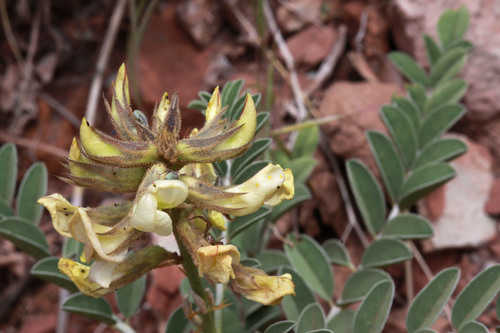


Spine-Noded Milkvetch
peteria thompsoniae
The Spine-Noded Milkvetch (Peteria thompsoniae) is a ruggedly beautiful perennial herb endemic to the arid, high-desert regions of the western United States, particularly within the Colorado Plateau and Great Basin. Belonging to the pea family (Fabaceae), this hardy wildflower thrives in harsh, nutrient-poor soils where few other plants can survive. It plays a subtle yet vital role in its ecosystem by stabilizing loose desert soils and providing nectar for native bees. What makes this plant truly remarkable is its suite of survival strategies. From its woody, tuberous root system that stores water deep underground to its spine-tipped leaf nodes that deter foraging desert herbivores, the Spine-Noded Milkvetch is perfectly engineered for drought and defense. Its pale yellow to cream-colored blossoms add a splash of delicate beauty to the rugged clay hills and gravelly washes it calls home, making it a rewarding find for keen-eyed desert explorers.
Lebensraum: Found in arid desert shrublands, clay hills, gravelly washes, and pinyon-juniper woodlands of the western United States.
This perennial herb typically grows between 10 to 40 centimeters tall, featuring erect, branching stems armed with sharp, spine-like stipules at the base of each leaf. The leaves are pinnately compound, divided into numerous small, oval, grayish-green leaflets that help reduce water loss in arid environments. In late spring, it produces terminal flower clusters of pale yellow, greenish-white, or cream-colored pea-like blossoms, which later develop into dry, elongated, light brown seed pods containing small, hard seeds.
Kategorie
PflanzenSeltenheit
Common
Gefahr
1/5 · Sehr gering
Snaps
Mach den ersten Snap!
Despite its delicate cream-colored flowers, the plant is heavily defended by sharp, woody spines at its leaf nodes to ward off hungry desert animals.
Its deep, potato-like tuberous roots allow it to store water and survive underground during years of severe drought, remaining dormant if necessary.
Like many other members of the pea family, it hosts beneficial bacteria in its roots that actively enrich the surrounding desert soil with nitrogen, aiding nearby plant communities.
Features sharp, woody stipules at its leaf nodes that act as thorns to deter hungry desert herbivores.
Maintains a thick, tuberous root system deep underground that stores nutrients and moisture to survive prolonged droughts.
Collaborates with specialized soil bacteria to convert atmospheric nitrogen into vital nutrients, enriching poor desert soils.
As a photoautotrophic plant, it produces its own energy using sunlight, carbon dioxide, and water through photosynthesis.
Rhizobium leguminosarum
Forms a mutualistic relationship with nitrogen-fixing soil bacteria in its root nodules.
Megachile apicalis
Provides nectar and pollen to native desert bees during its late spring blooming period.
Für dieses Objekt sind noch keine Merkmal-Badges vergeben.
Noch keine Alternativnamen vorhanden.
Sammlungen für dieses Objekt erscheinen hier, wenn weitere Themen hinzugefügt werden.
Gefahr
1/5 · Sehr gering
Noch keine besonderen Sicherheitshinweise.
Der einfachste Weg, Spine-Noded Milkvetch zu bestimmen, ist die Verwendung der Naturführer-App Snappit.
10-40 cm
0.05-0.2 kg
3-10 Jahre
As a photoautotrophic plant, it produces its own energy using sunlight, carbon dioxide, and water through photosynthesis.
Found in arid desert shrublands, clay hills, gravelly washes, and pinyon-juniper woodlands of the western United States.
Zoome hinein, um Cluster aufzulösen und zu sehen, wo dieses Objekt fotografiert wurde.
Neueste Snaps erscheinen hier, wenn neue Beobachtungen hinzukommen.