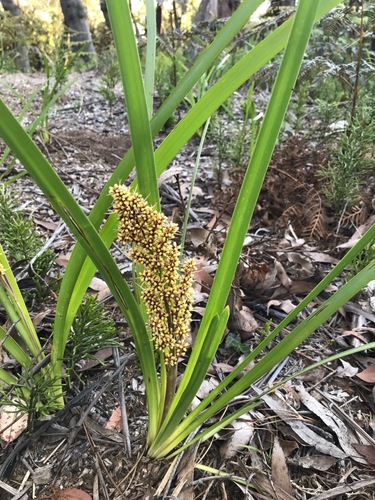


Spiny-Headed Mat-Rush
lomandra longifolia
The Spiny-Headed Mat-Rush (Lomandra longifolia) is a remarkably resilient and versatile perennial plant native to Australia. Forming dense, grass-like tussocks, it is a cornerstone species in various ecosystems, admired for its hardiness and adaptability. This plant is not only ecologically significant for its role in soil stabilization and as a food source for native fauna, but it also holds deep cultural importance for Indigenous Australians, who traditionally used its leaves for weaving and its leaf bases for food. Its architectural form and low-maintenance nature have made it a highly popular choice in modern landscaping and restoration projects.
Lebensraum: Found in a diverse range of habitats, from coastal dunes and heathlands to open forests, woodlands, and along watercourses and swamps across eastern Australia.
Lomandra longifolia features long, strap-like leaves, typically a vibrant dark green, that can grow between 50 to 100 centimeters in length. The leaf margins are often serrated or have small spines, giving rise to its common name. The plant produces distinctive flowering spikes (inflorescences) that emerge from the center of the tussock, bearing numerous small, creamy-yellow to white flowers. These flowers, which appear mainly in spring and summer, are often fragrant and clustered along the stem, creating a spiky, brush-like appearance.
Kategorie
PflanzenSeltenheit
Common
Gefahr
1/5 · Sehr gering
Snaps
Mach den ersten Snap!
Indigenous Australians traditionally used the strong, fibrous leaves of Lomandra longifolia for weaving durable baskets, mats, and fishing nets, showcasing its versatility.
Its deep root system is highly effective in preventing soil erosion, making it a popular choice for revegetation projects, particularly on embankments and along waterways.
Lomandra longifolia is dioecious, meaning individual plants bear either male or female flowers, which is a common but interesting reproductive strategy among plants.
The pale, fleshy bases of the leaves were a traditional food source for Aboriginal people, known for their sweet, nutty flavor when chewed.
Possesses a robust, fibrous root system that allows it to access deep soil moisture, enabling survival through prolonged dry periods with minimal water.
Capable of resprouting vigorously from its underground rhizomatous rootstock after bushfires, contributing to ecosystem recovery in fire-prone landscapes.
Its dense, extensive root network effectively binds soil particles, making it an excellent plant for stabilizing slopes, riverbanks, and areas prone to erosion.
As an autotrophic plant, Lomandra longifolia produces its own food through the process of photosynthesis, converting light energy into chemical energy in the form of sugars.
Lasioglossum species
Pollinates the plant, aiding in reproduction.
Wallabia bicolor
Feeds on the leaves, especially younger growth.
Various species
Forms symbiotic associations with the plant's roots, enhancing nutrient uptake.
Macropus species
Grazes on the foliage, helping to manage growth.
Für dieses Objekt sind noch keine Merkmal-Badges vergeben.
Noch keine Alternativnamen vorhanden.
Sammlungen für dieses Objekt erscheinen hier, wenn weitere Themen hinzugefügt werden.
Gefahr
1/5 · Sehr gering
Noch keine besonderen Sicherheitshinweise.
Der einfachste Weg, Spiny-Headed Mat-Rush zu bestimmen, ist die Verwendung der Naturführer-App Snappit.
50-150 cm
1.5-10 kg
20-50 Jahre
As an autotrophic plant, Lomandra longifolia produces its own food through the process of photosynthesis, converting light energy into chemical energy in the form of sugars.
Found in a diverse range of habitats, from coastal dunes and heathlands to open forests, woodlands, and along watercourses and swamps across eastern Australia.
Photosynthesis
Zoome hinein, um Cluster aufzulösen und zu sehen, wo dieses Objekt fotografiert wurde.
Neueste Snaps erscheinen hier, wenn neue Beobachtungen hinzukommen.















