

Spiny Senna
senna armata
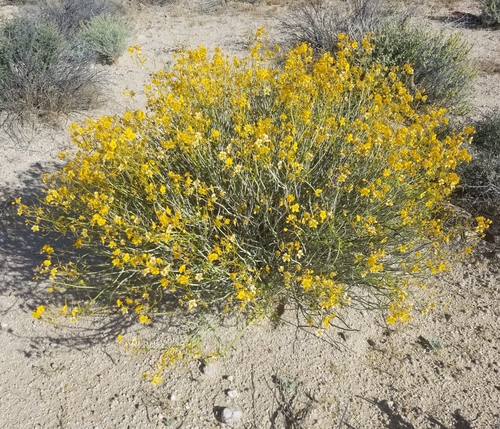
Meet the Spiny Senna (Senna armata), a remarkable desert survivor native to the arid landscapes of the Mojave and Sonoran Deserts in North America. At first glance, this resilient shrub resembles a chaotic, tangled dome of leafless green sticks, but this rugged appearance is a highly evolved strategy for thriving under the scorching desert sun. When spring arrives, this seemingly dead or dormant shrub undergoes a stunning transformation, bursting into a vibrant canopy of fragrant, bright yellow blossoms that feed local pollinators. As a member of the legume family, the Spiny Senna plays a vital role in its ecosystem. Its deep root system stabilizes desert soils, while its nutrient-rich leaves and flowers provide critical sustenance for desert tortoises, insects, and other native wildlife. Its ability to photosynthesize directly through its green stems makes it an exceptionally adapted perennial that stands as a symbol of desert endurance.
Lebensraum: Found in sandy washes, dry gravelly slopes, and desert flats of the Mojave and Colorado deserts.
Spiny Senna is a highly branched, rounded shrub reaching 1 to 1.5 meters in height and width. Its most distinctive feature is its network of pale green, smooth stems that terminate in sharp, spine-like tips. During dry periods, the plant appears entirely leafless, but after rare rains, it produces small, pinnate leaves with 2 to 4 pairs of leaflets that are quickly shed. In the spring, it is adorned with clusters of intensely fragrant, five-petaled yellow flowers about 1.5 centimeters wide, which later develop into narrow, elongated seed pods.
Kategorie
PflanzenSeltenheit
Common
Gefahr
1/5 · Sehr gering
Snaps
Mach den ersten Snap!
Despite looking like a dead bunch of thorns during dry seasons, the plant is fully alive and actively photosynthesizing through its green bark.
Its seed pods are designed to pop open or disintegrate, letting desert winds and flash floods disperse the seeds across sandy washes.
The flowers of the Spiny Senna release an exceptionally sweet, heavy fragrance that can be smelled from yards away in the desert heat.
To conserve water in extreme heat, this plant sheds its leaves and conducts photosynthesis directly through the green chlorophyll in its stems.
It drops its leaves almost immediately during dry spells to prevent moisture loss through transpiration.
The tips of its branches taper into sharp, woody spines that deter desert herbivores from grazing on its tender inner tissues.
As a photoautotrophic plant, the Spiny Senna produces its own energy by utilizing sunlight, carbon dioxide, and water through photosynthesis.
Gopherus agassizii
Desert tortoises graze on the low-hanging flowers and fallen leaves of the plant for hydration and nutrition.
Xylocopa varipuncta
Desert carpenter bees visit the bright yellow flowers to collect nectar and assist in pollination.
Phoebis sennae
Caterpillars of sulphur butterflies feed on the leaves and flowers, using the plant as a host.
Für dieses Objekt sind noch keine Merkmal-Badges vergeben.
Noch keine Alternativnamen vorhanden.
Sammlungen für dieses Objekt erscheinen hier, wenn weitere Themen hinzugefügt werden.
Gefahr
1/5 · Sehr gering
Noch keine besonderen Sicherheitshinweise.
Der einfachste Weg, Spiny Senna zu bestimmen, ist die Verwendung der Naturführer-App Snappit.
100-150 cm
10-30 Jahre
As a photoautotrophic plant, the Spiny Senna produces its own energy by utilizing sunlight, carbon dioxide, and water through photosynthesis.
Found in sandy washes, dry gravelly slopes, and desert flats of the Mojave and Colorado deserts.
Zoome hinein, um Cluster aufzulösen und zu sehen, wo dieses Objekt fotografiert wurde.
Neueste Snaps erscheinen hier, wenn neue Beobachtungen hinzukommen.















