

Spotted Dichomeris Moth And Allies
dichomeris punctidiscellus
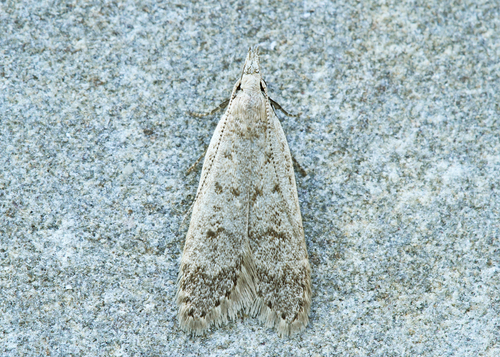
The Spotted Dichomeris Moth (Dichomeris punctidiscellus) is a fascinating, diminutive member of the twirler moth family, Gelechiidae. Measuring only a fraction of an inch across, these delicate insects are a testament to the intricate, hidden biodiversity of North American woodlands. Like many twirler moths, they are characterized by their specialized, upward-curving palpi that resemble a tiny snout, giving them a distinct profile when resting on tree bark. Although small and often overlooked, they play an essential role in their local ecosystems. As larvae, they act as leaf-tiers, using silk to subtly shape the micro-environment of their host plants to avoid predators. Meanwhile, the adult moths serve as a vital, nutrient-rich food source for nocturnal predators like bats and spiders. Spotting this subtly spotted micro-moth provides a wonderful glimpse into the intricate food webs of our native deciduous forests.
Lebensraum: Typically found in temperate deciduous forests, woodland edges, and adjacent brushy habitats where host plants for their caterpillars are abundant.
This micro-moth features a highly streamlined resting posture and a diminutive wingspan ranging between 12 and 16 millimeters. Its forewings are predominantly yellowish-brown to buff, finely speckled and punctuated with several distinct darker brown to black dots across the median area, giving the species its 'spotted' moniker. When at rest, the moth folds its wings tightly against its body, creating a narrow, splinter-like shape that mimics tree bark. Its most distinctive physical trait is its prominent, recurved labial palpi, which are sensory mouthparts that curve upwards in front of its face, resembling small horns or an upturned snout.
Kategorie
InsektenSeltenheit
Common
Gefahr
1/5 · Sehr gering
Snaps
Mach den ersten Snap!
Despite their minuscule size, the upward-curved palpi on their faces act like highly tuned chemical receptors, helping them find mates over relatively long distances in the dark.
Members of the Gelechiidae family are commonly called twirler moths because many of them have a habit of spinning in tight circles when disturbed.
The family name Gelechiidae is derived from a Greek word meaning to rest on the earth, which refers to the flat resting posture of many species in this group.
As caterpillars, they use silk threads to tie plant leaves together, creating a sheltered micro-habitat that protects them from predators and harsh weather while feeding.
The adults' earth-toned, spotted wings allow them to blend seamlessly into tree bark, lichen, and dried vegetation during the day.
They possess highly developed, recurved labial palpi that function as a specialized antenna system to detect environmental and chemical cues in the dark.
Larvae are herbivorous leaf-tiers feeding on the foliage of deciduous trees and shrubs, while adults mainly rely on nectar or stored energy reserves.
Altersunterschiede: Larvae consume solid plant tissue such as leaves, whereas adults consume liquid nectar or do not feed significantly.
Eptesicus fuscus
Bats prey on adult moths in mid-air during their nocturnal flights.
Ichneumonidae
Parasitoid wasps lay their eggs inside the moth's larvae, eventually killing the host.
Araneus diadematus
Web-building spiders routinely capture and consume the adult moths in woodland environments.
Für dieses Objekt sind noch keine Merkmal-Badges vergeben.
Sammlungen für dieses Objekt erscheinen hier, wenn weitere Themen hinzugefügt werden.
Gefahr
1/5 · Sehr gering
Noch keine besonderen Sicherheitshinweise.
Der einfachste Weg, Spotted Dichomeris Moth And Allies zu bestimmen, ist die Verwendung der Naturführer-App Snappit.
1 cm
1-2 cm
0.00001-0.00005 kg
0-1 Jahre
Larvae are herbivorous leaf-tiers feeding on the foliage of deciduous trees and shrubs, while adults mainly rely on nectar or stored energy reserves.
Typically found in temperate deciduous forests, woodland edges, and adjacent brushy habitats where host plants for their caterpillars are abundant.
Foraging
Zoome hinein, um Cluster aufzulösen und zu sehen, wo dieses Objekt fotografiert wurde.
Neueste Snaps erscheinen hier, wenn neue Beobachtungen hinzukommen.

















