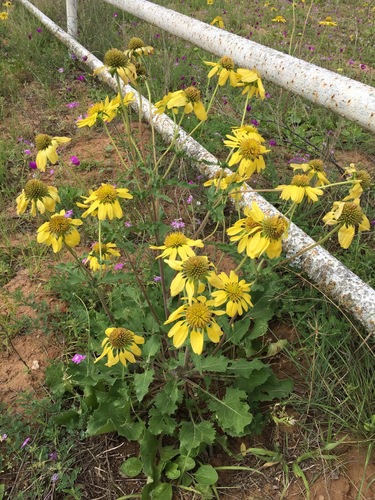


Square Bud Daisy
tetragonotheca repanda
The Square Bud Daisy (Tetragonotheca repanda) is a charming and resilient perennial wildflower native to the sandy pinelands and coastal plains of the southeastern United States. Belonging to the Asteraceae family, this plant is best known for its striking, square-shaped flower buds, which are formed by four large, leafy outer bracts. Once these buds unfurl, they reveal bright yellow daisy-like blossoms that light up the forest floor and sandy paths. As a hardy native species, the Square Bud Daisy plays a vital role in its local ecosystem, providing abundant nectar for native bees and butterflies. Its creeping growth habit and wavy-margined leaves make it an attractive groundcover in wild areas, and its ability to thrive in poor, sandy soils showcases its remarkable adaptability.
Lebensraum: Typically found in well-drained, sandy soils of open pine flatwoods, oak scrublands, and coastal plains.
This low-growing perennial features distinct wavy-edged, soft green leaves with a slightly fuzzy texture. Its most diagnostic feature is the square, four-sided bud composed of four large, green, leaf-like outer bracts that enclose the developing flower. When open, the flower displays 10 to 15 bright yellow ray florets surrounding a dense center of dark yellow disk florets, with the entire bloom measuring about 3 to 5 centimeters across. The stems are often reddish-green and slightly sprawling, reaching a height of 20 to 50 centimeters.
Kategorie
PflanzenSeltenheit
Common
Gefahr
1/5 · Sehr gering
Snaps
Mach den ersten Snap!
Its wavy, undulating leaf margins are the source of the specific epithet 'repanda,' which means turned-back or wavy in Latin.
The name Tetragonotheca translates directly to 'four-angled container,' referring to the perfectly square-shaped outer bracts of the flower bud.
While it looks like a single flower, like all members of the Aster family, each daisy is actually a composite of dozens of tiny individual flowers.
The unique square outer bracts tightly seal and protect the delicate developing floral organs from herbivorous insects and harsh sunlight.
Maintains a deep taproot system that allows the plant to access moisture deep within loose, sandy soils during dry spells.
Produces highly concentrated nectar that specifically attracts specialized native bee pollinators, ensuring high fertilization rates.
As a photosynthetic plant, it generates its own energy from sunlight, carbon dioxide, and water, supplemented by mineral absorption from sandy soils.
Synchlora aerata
The caterpillars of this moth feed on the foliage and flower heads of various Asteraceae, including the Square Bud Daisy.
Lasioglossum pectorale
Adult bees visit the yellow flowers to forage for pollen and nectar, acting as primary pollinators.
Aristida stricta
Competes for space, sunlight, and soil nutrients in sandy pine understories.
Für dieses Objekt sind noch keine Merkmal-Badges vergeben.
Noch keine Alternativnamen vorhanden.
Sammlungen für dieses Objekt erscheinen hier, wenn weitere Themen hinzugefügt werden.
Gefahr
1/5 · Sehr gering
Noch keine besonderen Sicherheitshinweise.
Der einfachste Weg, Square Bud Daisy zu bestimmen, ist die Verwendung der Naturführer-App Snappit.
20-50 cm
3-7 Jahre
As a photosynthetic plant, it generates its own energy from sunlight, carbon dioxide, and water, supplemented by mineral absorption from sandy soils.
Typically found in well-drained, sandy soils of open pine flatwoods, oak scrublands, and coastal plains.
14-28 Tage
Zoome hinein, um Cluster aufzulösen und zu sehen, wo dieses Objekt fotografiert wurde.
Neueste Snaps erscheinen hier, wenn neue Beobachtungen hinzukommen.














_BHL23630341.jpg&width=800)



