

Square-Headed Wasps, Sand Wasps, And Allies
crabronidae
The Crabronidae family, commonly referred to as square-headed wasps, sand wasps, and allies, represents a remarkably diverse and ecologically vital group of solitary wasps. Unlike their social relatives, these industrious insects do not build large paper nests or live in colonies. Instead, individual females excavate tunnels in sandy soil, utilize hollow plant stems, or nest in pre-existing cavities. They are highly valued by gardeners and farmers alike as natural pest control agents, actively hunting a wide range of insects—including aphids, flies, and caterpillars—to provision their subterranean nests for their developing offspring. Adult crabronids are gentle giants of the wasp world, typically ignoring humans as they forage peacefully on wildflowers for nectar. Their highly specialized nesting habits and fascinating maternal behaviors, such as 'progressive provisioning' where mothers feed their growing larvae daily, make them an endless source of fascination for entomologists and nature lovers alike.
Lebensraum: They are typically found in open, sunny areas with sandy or loose soils, including dunes, riverbanks, gardens, and forest edges.
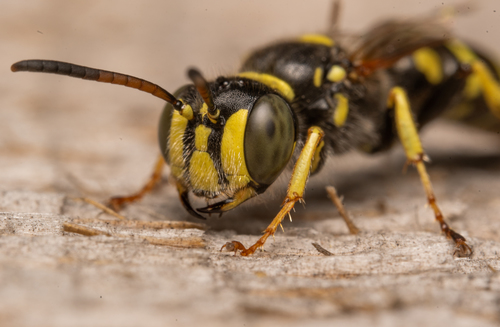
These wasps are visually distinguished by their characteristic large, blocky, 'square-shaped' heads and highly mobile, wide-set eyes. Their bodies vary widely in coloration, often displaying bold warning patterns of yellow, white, or red contrasted against a black base, though some species exhibit a metallic blue or green sheen. They have a relatively stocky, robust build compared to slender-waisted paper wasps, and they range in size from small 5 mm specimens to impressive 30 mm giants. Their clear or smoky-tinted wings are held flat or slightly parted over their abdomens when resting, ready for their characteristically rapid, hovering flight patterns.
Kategorie
InsektenSeltenheit
Common
Gefahr
1/5 · Sehr gering
Snaps
Mach den ersten Snap!
Despite their intimidating warning colors and stinger, solitary wasps like Crabronidae are incredibly non-aggressive and will only sting humans if handled roughly.
Sand wasps (Bembicinae) practice progressive provisioning, which means the mother wasp continues to bring fresh flies to her developing larvae every day, much like a bird feeding its nestlings.
Some members of this family, known as 'beewolves', specialize in hunting honey bees, paralyzing them with a sting to the neck.
Females utilize a highly precise sting to paralyze prey without killing it, ensuring the food remains fresh for their subterranean larvae.
Equipped with specialized bristles on their forelegs called 'tarsal combs', they can rapidly shovel loose sand and soil backwards to dig nesting tunnels.
Some species cultivate beneficial Streptomyces bacteria in their antennal glands to apply to their cocoons, protecting their pupae from fungal infections.
Adults feed exclusively on flower nectar and honeydew, while they hunt insects and spiders to provision their carnivorous larvae.
Apis mellifera
Beewolves (genus Philanthus) hunt honey bees to provision their larval cells.
Daucus carota
Adult crabronid wasps feed heavily on the nectar of wild carrot flowers.
Senotainia trilineata
Satellite flies trail nesting wasps and lay larvae on the prey before it is sealed in the nest.
Für dieses Objekt sind noch keine Merkmal-Badges vergeben.
Sammlungen für dieses Objekt erscheinen hier, wenn weitere Themen hinzugefügt werden.
Gefahr
1/5 · Sehr gering
Noch keine besonderen Sicherheitshinweise.
Der einfachste Weg, Square-Headed Wasps, Sand Wasps, And Allies zu bestimmen, ist die Verwendung der Naturführer-App Snappit.
1+ cm
1+ cm
0.00001+ kg
0+ Jahre
25 km/h
Adults feed exclusively on flower nectar and honeydew, while they hunt insects and spiders to provision their carnivorous larvae.
They are typically found in open, sunny areas with sandy or loose soils, including dunes, riverbanks, gardens, and forest edges.
Zoome hinein, um Cluster aufzulösen und zu sehen, wo dieses Objekt fotografiert wurde.
Neueste Snaps erscheinen hier, wenn neue Beobachtungen hinzukommen.








_Misumena_vatia_male.jpg&width=800)







