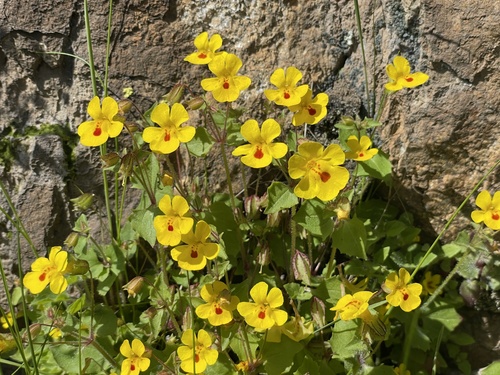


Stanislaus Monkeyflower
erythranthe marmorata
The Stanislaus Monkeyflower (Erythranthe marmorata) is a rare and striking annual wildflower endemic to the Sierra Nevada foothills of California. Once part of the large Mimulus genus, it thrives in highly specific microhabitats like rocky seepages and moist granitic outcrops. Because its habitat dries up rapidly as the intense California summer approaches, this diminutive plant employs a fast-paced lifecycle, bursting into brilliant bloom during the spring before quickly setting seed and dying back. Its charming, asymmetrical flowers and specialized niche make it a fascinating find for botanists and native plant enthusiasts exploring California's unique floristic provinces.
Lebensraum: Found exclusively on moist, mossy granitic outcrops, shallow rocky soils, and seasonal seepages in the Sierra Nevada foothills of California.
This tiny annual herb typically stands only 2 to 15 centimeters tall. It produces striking, bilaterally symmetrical, tubular flowers that are bright yellow and frequently adorned with dark red or maroon speckling and marbling on the lower lip, a feature that inspired its specific epithet, marmorata. Its green to slightly reddish-tinged leaves are arranged in opposite pairs along the stem, often featuring a somewhat hairy texture and gently toothed margins.
Kategorie
PflanzenSeltenheit
Common
Gefahr
1/5 · Sehr gering
Snaps
Mach den ersten Snap!
In a major taxonomic shakeup in 2012, this plant and many other North American monkeyflowers were moved from the genus Mimulus to Erythranthe based on DNA evidence.
Monkeyflowers get their common name because some people think their highly asymmetrical, bilabiate flowers look like a grinning monkey's face.
The species name 'marmorata' translates to 'marbled', referring to the beautiful red-brown patterns on the plant's bright yellow petals.
Adapts to seasonal droughts by germinating, flowering, and setting seed rapidly while spring moisture is available before the harsh summer begins.
Utilizes distinct maroon marbling and spotting on its lower petals to guide native bees and other pollinators directly to its nectar and reproductive organs.
Specially adapted to grow in extremely thin, nutrient-poor soils found on granite slabs that receive only brief, seasonal water flow.
As an autotrophic plant, it produces its own energy and nutrients through photosynthesis.
Bombus vosnesenskii
Pollinates the flowers while foraging for nectar.
Junonia coenia
Caterpillars may occasionally feed on the foliage of native monkeyflowers.
Erythranthe guttata
Competes for limited space and moisture in Sierra Nevada seasonal seepages.
Für dieses Objekt sind noch keine Merkmal-Badges vergeben.
Noch keine Alternativnamen vorhanden.
Sammlungen für dieses Objekt erscheinen hier, wenn weitere Themen hinzugefügt werden.
Gefahr
1/5 · Sehr gering
Noch keine besonderen Sicherheitshinweise.
Der einfachste Weg, Stanislaus Monkeyflower zu bestimmen, ist die Verwendung der Naturführer-App Snappit.
2-15 cm
1 Jahre
As an autotrophic plant, it produces its own energy and nutrients through photosynthesis.
Found exclusively on moist, mossy granitic outcrops, shallow rocky soils, and seasonal seepages in the Sierra Nevada foothills of California.
Photosynthesis
50-300
7-14 Tage
Zoome hinein, um Cluster aufzulösen und zu sehen, wo dieses Objekt fotografiert wurde.
Neueste Snaps erscheinen hier, wenn neue Beobachtungen hinzukommen.









_DDumais.jpg&width=800)