

Stinking Passionflower
passiflora foetida
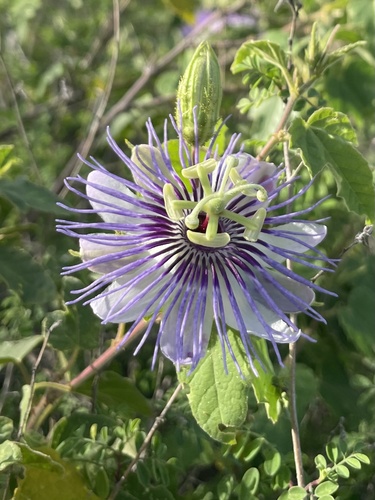
The Stinking Passionflower is a fast-growing, creeping vine native to the tropical Americas but now widely naturalized across the globe. Known for the strong, unpleasant odor released when its foliage is bruised, this remarkable plant has adapted beautifully to disturbed habitats, roadsides, and forest edges. Its delicate, elaborate flowers are a marvel of evolutionary design, showcasing a complex arrangement of white-to-pale-purple petals and thread-like corona filaments.
Lebensraum: Typically found in disturbed areas, forest edges, dry fields, coastal scrub, and roadsides in tropical and subtropical regions.
This climbing vine is easily identified by its alternate, three-lobed leaves covered in fine, sticky glandular hairs. The striking flowers, measuring 2 to 5 centimeters across, are cream-colored to pale pinkish-purple and are uniquely enveloped by a deeply divided, lace-like collar of sticky green bracts. As the flower matures, it produces a round, paper-wrapped berry that transitions from green to a vibrant yellow-orange or red when fully ripe.
Kategorie
PflanzenSeltenheit
Common
Gefahr
1/5 · Sehr gering
Snaps
Mach den ersten Snap!
Its lace-like bracts are covered in sticky glands that trap insects, making it a protocarnivorous plant, though scientists still debate if it fully digests them.
The ripe, sweet yellow-to-orange fruits are edible and eaten in many parts of the world, but the unripe green fruits are toxic due to cyanogenic glycosides.
The species name 'foetida' translates to 'stinking' in Latin, referencing the pungent aroma released when the foliage is touched.
It utilizes sticky, glandular hairs on its lacy bracts to trap small insects, which may deter pests or provide supplemental nutrients.
Its leaves emit a foul, musty odor and contain cyanogenic glycosides that deter herbivorous mammals and insects from feeding.
Highly sensitive axillary tendrils wrap around nearby structures upon touch, allowing the vine to quickly climb and secure sunlight.
As a photoautotrophic plant, it synthesizes its own food using sunlight while supplementing nutrients by trapping small insects.
Acraea terpsicore
Caterpillars feed on the foliage, utilizing the plant's toxins for their own chemical defense.
Agraulis vanillae
Caterpillars use this vine as a primary host plant, feeding heavily on the leaves.
Apis mellifera
Bees visit the flowers for nectar and pollen, acting as key pollinators.
Für dieses Objekt sind noch keine Merkmal-Badges vergeben.
Sammlungen für dieses Objekt erscheinen hier, wenn weitere Themen hinzugefügt werden.
Gefahr
1/5 · Sehr gering
Noch keine besonderen Sicherheitshinweise.
Der einfachste Weg, Stinking Passionflower zu bestimmen, ist die Verwendung der Naturführer-App Snappit.
150-500 cm
2-5 Jahre
As a photoautotrophic plant, it synthesizes its own food using sunlight while supplementing nutrients by trapping small insects.
Typically found in disturbed areas, forest edges, dry fields, coastal scrub, and roadsides in tropical and subtropical regions.
Passive Trapping
14-30 Tage
Zoome hinein, um Cluster aufzulösen und zu sehen, wo dieses Objekt fotografiert wurde.
Neueste Snaps erscheinen hier, wenn neue Beobachtungen hinzukommen.
Texas, US
Hier kann man sehen Ente, Mexikanischer Bootschwanz und Nilgans.
Führer anzeigen →

Hawaii, US
Hier kann man sehen ʻōhiʻa Lehua, Stinking Passionflower und Strandwinde.
Führer anzeigen →
















_Teucrium_fruticans_-_Flowers.jpg&width=800)



