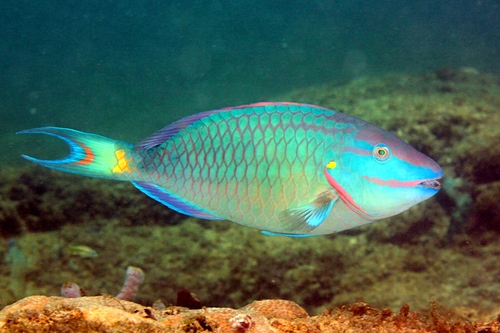


Stoplight Parrotfish
sparisoma viride
The Stoplight Parrotfish (Sparisoma viride) is a colorful and ecologically vital inhabitant of coral reefs in the tropical western Atlantic. Named for the bright yellow spot near its tail fin, which resembles a traffic light in certain color phases, this fish plays a crucial role in maintaining reef health. Like other parrotfish, it is famous for its vibrant color phases and its ability to change sex from female to male. As busy herbivores, they spend their days scraping algae off rocks and coral with their fused, beak-like teeth. This continuous grazing prevents algae from smothering the reef, which in turn facilitates new coral growth. Their constant feeding cycle also contributes significantly to the production of fine white coral sand, helping to shape the beautiful beaches of their tropical habitats.
Lebensraum: Found in coral reefs, seagrass beds, and shallow rocky coastal waters across the tropical Western Atlantic.
This species exhibits dramatic color changes depending on its life stage. In the initial phase, which includes females and young males, they display a dark red to brown body with bright red scales on their underbelly and a white bar on the tail. Terminal phase males, often called supermales, are strikingly colorful, featuring a vibrant green or blue-green body, yellow markings on the tail base and gill cover, and a bright orange-red band across the tail fin. They possess robust, fused beak-like jaws and can reach lengths up to 64 centimeters.
Kategorie
FischeSeltenheit
Common
Gefahr
1/5 · Sehr gering
Snaps
Mach den ersten Snap!
The sandy beaches of the Caribbean are largely made of poop from parrotfish, which grind up coral skeletons and excrete them as fine sand.
They can change their sex from female to male, completely transforming their color from red-and-grey to brilliant emerald green.
You can actually hear these fish feeding underwater; their fused beak-like teeth make a loud scraping sound against the coral reef.
They can transition from female to male during their lifespan, changing their behavior, coloration, and reproductive role to maximize breeding success.
Using their powerful beak-like teeth, they scrape off algae-covered coral, grinding the limestone skeleton in their throat to produce fine white sand.
At night, they can secrete a protective mucus cocoon around themselves to mask their scent and deter nocturnal predators like sharks.
They feed primarily on turf algae and microalgae growing on dead coral, utilizing their beak-like teeth to scrape the substrate.
Altersunterschiede: Juveniles eat smaller turf algae and small invertebrates, while adults consume larger quantities of calcareous algae and coral material.
Orbicella faveolata
Provides nutrition through algae grazing, while accidentally scraping the coral skeleton.
Carcharhinus perezi
Preys upon the parrotfish, especially when they are vulnerable at night.
Elacatinus evelynae
Cleans parasites and dead skin off the parrotfish's body in a mutually beneficial relationship.
Für dieses Objekt sind noch keine Merkmal-Badges vergeben.
Noch keine Alternativnamen vorhanden.
Sammlungen für dieses Objekt erscheinen hier, wenn weitere Themen hinzugefügt werden.
Gefahr
1/5 · Sehr gering
Noch keine besonderen Sicherheitshinweise.
Der einfachste Weg, Stoplight Parrotfish zu bestimmen, ist die Verwendung der Naturführer-App Snappit.
3064+ cm
0.816+ kg
510+ Jahre
15 km/h
They feed primarily on turf algae and microalgae growing on dead coral, utilizing their beak-like teeth to scrape the substrate.
Found in coral reefs, seagrass beds, and shallow rocky coastal waters across the tropical Western Atlantic.
Grazing
Zoome hinein, um Cluster aufzulösen und zu sehen, wo dieses Objekt fotografiert wurde.
Neueste Snaps erscheinen hier, wenn neue Beobachtungen hinzukommen.










%2C_mar_Rojo%2C_Egipto%2C_2023-04-17%2C_DD_90.jpg&width=800)





.jpg&width=800)


