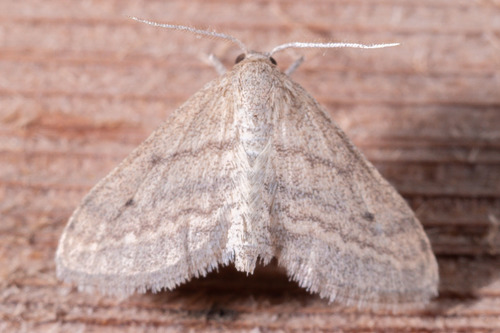


Straight-Lined Wave
lobocleta plemyraria
The Straight-Lined Wave moth (Lobocleta plemyraria) is a delicate and fascinating member of the geometer moth family, Geometridae. Commonly found throughout the southeastern United States, this small, understated moth is known for its subtle beauty and quiet presence in grasslands, old fields, and open woodlands. Characterized by its pale coloration and fine, straight transverse lines running across its wings, it blends seamlessly into dry grasses and foliage. Like many geometrid moths, its caterpillars are loopers or "inchworms," moving with a characteristic looping gait that captures the imagination of nature observers. Despite its modest size and cryptic nature, the Straight-Lined Wave plays an important role in its local ecosystem, acting as a minor pollinator during its adult stage and serving as a critical food source for various insectivorous birds, spiders, and predatory invertebrates.
Lebensraum: Found in open woodlands, sandy fields, grasslands, and suburban gardens across the southeastern United States.
This small moth has a wingspan ranging from 1.5 to 2.2 centimeters. Its wings are typically a pale yellowish-white, cream, or light tan, adorned with fine, relatively straight brown or grayish transverse lines that run parallel to the outer margins. A tiny, dark discal spot is often visible near the center of each wing, though it can be faint on worn individuals. At rest, it holds its wings completely flat and pressed against the substrate, forming a neat triangular shape that helps obscure its outline against tree bark, dry leaves, or plant stems.
Kategorie
InsektenSeltenheit
Common
Gefahr
1/5 · Sehr gering
Snaps
Mach den ersten Snap!
Artificial light sources are highly attractive to this species, making backyard porch lights one of the absolute best spots for amateur entomologists to find them.
The family name Geometridae translates to 'earth-measurer' in Greek, describing how the looping caterpillars appear to measure the ground as they walk.
Unlike many moth species that fold their wings over their backs, the Straight-Lined Wave rests with its wings completely flat against the surface to minimize its physical profile.
When resting, this moth presses its wings completely flat against surfaces to eliminate shadows, allowing it to blend perfectly into background vegetation.
In the larval stage, it lacks middle abdominal prolegs, forcing it to draw its rear forward to its front legs to form a loop for highly efficient climbing.
Adult moths use highly sensitive chemoreceptors located on their antennae and tarsi to detect trace chemical cues from nocturnal blooms.
Caterpillars feed on the foliage of low-growing herbaceous plants and asters, while adult moths primarily sip nectar from various wildflowers.
Poecile carolinensis
Adults and caterpillars are preyed upon by small insectivorous woodland birds.
Parasteatoda tepidariorum
Adult moths are frequently intercepted and consumed by spiders when flying near low vegetation or lights.
Solidago altissima
The caterpillars utilize various low-growing aster plants as primary larval host plants.
Für dieses Objekt sind noch keine Merkmal-Badges vergeben.
Noch keine Alternativnamen vorhanden.
Sammlungen für dieses Objekt erscheinen hier, wenn weitere Themen hinzugefügt werden.
Gefahr
1/5 · Sehr gering
Noch keine besonderen Sicherheitshinweise.
Der einfachste Weg, Straight-Lined Wave zu bestimmen, ist die Verwendung der Naturführer-App Snappit.
0+ cm
1+ cm
0+ kg
0+ Jahre
8 km/h
Caterpillars feed on the foliage of low-growing herbaceous plants and asters, while adult moths primarily sip nectar from various wildflowers.
Found in open woodlands, sandy fields, grasslands, and suburban gardens across the southeastern United States.
Zoome hinein, um Cluster aufzulösen und zu sehen, wo dieses Objekt fotografiert wurde.
Neueste Snaps erscheinen hier, wenn neue Beobachtungen hinzukommen.








.JPG&width=800)
