

Straw-Colored Flatsedge
cyperus strigosus
The Straw-Colored Flatsedge (Cyperus strigosus) is a resilient, perennial sedge native to North America. Often found growing in dense, vibrant clumps in damp soils, this species plays a vital role in stabilizing shorelines and wetland soils against erosion. With its striking umbrella-like appearance and golden-yellow seed heads, it is a key ecological contributor that filters nutrients and provides shelter for small wetland creatures.
Lebensraum: Found in wet meadows, marshes, stream banks, damp ditches, and moist disturbed areas.
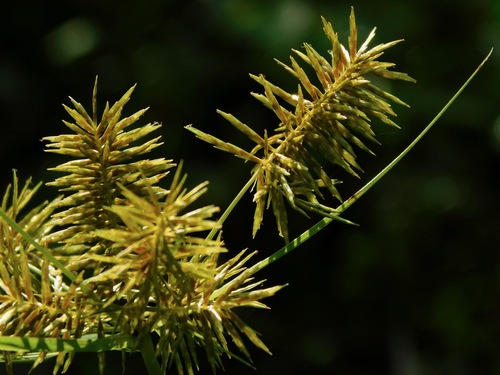
This plant typically stands between 20 to 100 centimeters tall, showcasing sharp, three-sided (triangular) stems that are smooth and hairless. At the top of each stem sits a whorl of long, leaf-like bracts pointing outwards like umbrella ribs, supporting flat, linear spikelets. These seed clusters transition from a pale green during early summer to a shiny, golden, straw-yellow color as autumn approaches.
Kategorie
PflanzenSeltenheit
Common
Gefahr
1/5 · Sehr gering
Snaps
Mach den ersten Snap!
A classic botanical rhyme helps identify this plant family: 'Sedges have edges, rushes are round, and grasses are hollow right up from the ground.'
Although often mistaken for a weed in agricultural fields, it is highly valued in ecological restoration for its superior soil-binding capabilities.
Its lightweight, flattened seeds are designed to float on water, using seasonal flooding to disperse to new moist habitats.
The distinct triangular cross-section of its stem provides enhanced structural stability against wind and flowing water.
Utilizes specialized internal air channels (aerenchyma) to transport vital oxygen from its leaves down to roots submerged in anaerobic mud.
Spreads through tough underground rhizomes, allowing it to quickly anchor itself and survive soil disturbances.
Produces its own energy through photosynthesis, utilizing sunlight, carbon dioxide, and water while absorbing essential soil nutrients through its roots.
Ondatra zibethicus
The rhizomes and lower stems of this flatsedge are dug up and eaten as a food source.
Euphyes dion
The larvae of this skipper butterfly feed on the leaves of Cyperus species.
Branta canadensis
Geese frequently graze on the tender young shoots and seed heads in wet pastures.
Für dieses Objekt sind noch keine Merkmal-Badges vergeben.
Noch keine Alternativnamen vorhanden.
Sammlungen für dieses Objekt erscheinen hier, wenn weitere Themen hinzugefügt werden.
Gefahr
1/5 · Sehr gering
Noch keine besonderen Sicherheitshinweise.
Der einfachste Weg, Straw-Colored Flatsedge zu bestimmen, ist die Verwendung der Naturführer-App Snappit.
20-100 cm
2-5 Jahre
Produces its own energy through photosynthesis, utilizing sunlight, carbon dioxide, and water while absorbing essential soil nutrients through its roots.
Found in wet meadows, marshes, stream banks, damp ditches, and moist disturbed areas.
Zoome hinein, um Cluster aufzulösen und zu sehen, wo dieses Objekt fotografiert wurde.
Neueste Snaps erscheinen hier, wenn neue Beobachtungen hinzukommen.