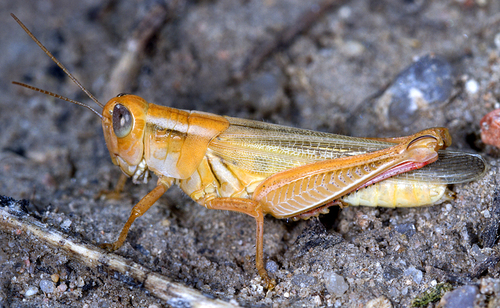


Striped Sand Grasshopper
melanoplus foedus
The Striped Sand Grasshopper (Melanoplus foedus) is a captivating inhabitant of North America's sandy grasslands, dunes, and riverbanks. Well-adapted to arid environments, this robust insect is a member of the spur-throated grasshopper family. It plays a crucial role in its local ecosystem, acting as a vital food source for numerous birds, reptiles, and small mammals, while also keeping native plant populations in check through its herbivorous grazing. Unlike some of its migratory relatives, the Striped Sand Grasshopper prefers to stay close to home, navigating the warm sands with remarkable agility. Its life cycle is beautifully synchronized with the seasons, transitioning from overwintering eggs to active summer nymphs and adults, filling the warm months with their silent, hopping presence.
Lebensraum: Found in open, sandy environments such as inland dunes, sandy riverbanks, blowouts, and loose-soil prairies.
Measuring between 2 to 5 centimeters in length, the Striped Sand Grasshopper features a stout, yellowish-brown to grayish body that offers excellent camouflage against sandy substrates. A prominent, dark stripe typically runs from behind each compound eye down the side of the pronotum, giving this species its common name. Its hind legs are large and highly developed for jumping, with the hind tibiae displaying a variable coloration that ranges from deep red to pale blue or yellow. When spread, its membranous hindwings are mostly clear or slightly tinted, allowing for short, fluttering flights when disturbed.
Kategorie
InsektenSeltenheit
Common
Gefahr
1/5 · Sehr gering
Snaps
Mach den ersten Snap!
Female Striped Sand Grasshoppers use their abdomen to dig deep into the sand, secreting a frothy fluid that hardens to protect their overwintering egg pods.
Their hind legs feature specialized spines that help them gain traction when jumping off loose, sliding sand dunes.
Unlike many other grasshoppers, the Striped Sand Grasshopper is highly specialized for loose, sandy soils and is rarely found in heavy clay or dense loam.
Its mottled gray-brown coloration and lateral striping allow it to blend seamlessly into sandy backgrounds, making it almost invisible to predators when stationary.
Equipped with highly muscular hind femur legs, it can launch itself multiple feet into the air to quickly escape approaching threats.
By adjusting its posture and orientation relative to the sun, this grasshopper can raise or lower its body temperature to survive extreme sand-surface heat.
Feeds primarily on a variety of sandy-soil grasses and broadleaf herbaceous plants, using its strong chewing mandibles to consume foliage.
Altersunterschiede: Nymphs feed on smaller, tender young shoots, while adults consume tougher, mature leaves and stems.
Lanius ludovicianus
Preys on the grasshopper during the nesting season.
Helianthus annuus
Commonly feeds on the leaves and stems of this plant in sandy environments.
Systoechus oreas
Larvae of this bee fly consume the subterranean eggs of the grasshopper.
Für dieses Objekt sind noch keine Merkmal-Badges vergeben.
Noch keine Alternativnamen vorhanden.
Sammlungen für dieses Objekt erscheinen hier, wenn weitere Themen hinzugefügt werden.
Gefahr
1/5 · Sehr gering
Noch keine besonderen Sicherheitshinweise.
Der einfachste Weg, Striped Sand Grasshopper zu bestimmen, ist die Verwendung der Naturführer-App Snappit.
2-5 cm
5-8 cm
0.001-0.003 kg
1 Jahre
12 km/h
Feeds primarily on a variety of sandy-soil grasses and broadleaf herbaceous plants, using its strong chewing mandibles to consume foliage.
Found in open, sandy environments such as inland dunes, sandy riverbanks, blowouts, and loose-soil prairies.
Zoome hinein, um Cluster aufzulösen und zu sehen, wo dieses Objekt fotografiert wurde.
Neueste Snaps erscheinen hier, wenn neue Beobachtungen hinzukommen.