

Sweetleaf
symplocos tinctoria
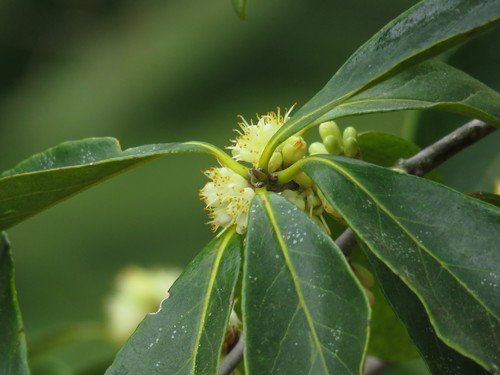
Sweetleaf, also known as horsesugar, is a charming, often multi-stemmed shrub or small tree native to the moist woodlands and coastal plains of the southeastern United States. It is celebrated for its sweet-tasting, leathery leaves which serve as a prized snack for local wildlife, particularly deer and horses. In early spring, before its new leaves fully unfurl, sweetleaf bursts into clusters of creamy-yellow, honey-scented blossoms that attract a lively hum of native pollinators. Historically, this versatile plant held significant value for early American settlers and Indigenous peoples, who extracted a brilliant yellow dye from its bark and leaves. Today, it stands as an ecologically valuable understory species, providing shelter and sustenance in sandy pine lands and swampy margins alike.
Lebensraum: Typically found in moist, acidic soils of the southeastern United States, including floodplains, swamp margins, pine flatwoods, and maritime forests.
Sweetleaf typically grows as a large shrub or small tree reaching heights of 2 to 10 meters. Its leaves are simple, alternating, and elliptic to oblong, measuring 7 to 15 centimeters long with a shiny, dark-green upper surface and a pale, finely hairy underside. The most distinctive identification feature is the sweet flavor of the chewed leaf. In spring, dense, almost stalkless clusters of small, fragrant, pale yellow to white flowers with numerous protruding stamens line the twigs, later maturing into small, egg-shaped, dry green or brown drupes.
Kategorie
PflanzenSeltenheit
Common
Gefahr
1/5 · Sehr gering
Snaps
Mach den ersten Snap!
Although sweetleaf is technically a deciduous plant, in the warmer southern parts of its range, it behaves as a semi-evergreen, keeping its green leaves throughout the winter.
The common name 'Horsesugar' refers to the sweet flavor of the leaves, which are eagerly eaten by horses, cattle, and deer.
The scientific species name 'tinctoria' refers to its historical use as a source of rich yellow dye for early American textiles.
The leaves accumulate high concentrations of sweet-tasting compounds and minerals, making them highly palatable and nutrient-rich for wild herbivores.
The bark and leaves contain a high concentration of natural yellow pigments that historically made the plant a valuable source for textile dyes.
It successfully thrives under dense forest canopies, modifying its leaf retention from deciduous to semi-evergreen based on climate mildness.
As a photoautotrophic plant, sweetleaf synthesizes its own food using sunlight, carbon dioxide, and water through the process of photosynthesis.
Satyrium kingi
Sweetleaf acts as the primary larval host plant, providing essential nourishment to the caterpillars of this rare butterfly.
Odocoileus virginianus
Deer actively browse on the sweet, high-energy leaves and twigs, especially during the lean winter months.
Apis mellifera
Bees visit the fragrant spring blossoms to gather nectar and pollen, aiding in the plant's cross-pollination.
Für dieses Objekt sind noch keine Merkmal-Badges vergeben.
Noch keine Alternativnamen vorhanden.
Sammlungen für dieses Objekt erscheinen hier, wenn weitere Themen hinzugefügt werden.
Gefahr
1/5 · Sehr gering
Noch keine besonderen Sicherheitshinweise.
Der einfachste Weg, Sweetleaf zu bestimmen, ist die Verwendung der Naturführer-App Snappit.
200-1000 cm
20-60 Jahre
As a photoautotrophic plant, sweetleaf synthesizes its own food using sunlight, carbon dioxide, and water through the process of photosynthesis.
Typically found in moist, acidic soils of the southeastern United States, including floodplains, swamp margins, pine flatwoods, and maritime forests.
Zoome hinein, um Cluster aufzulösen und zu sehen, wo dieses Objekt fotografiert wurde.
Neueste Snaps erscheinen hier, wenn neue Beobachtungen hinzukommen.















_in_Hyderabad%2C_AP_W_IMG_9723.jpg&width=800)





