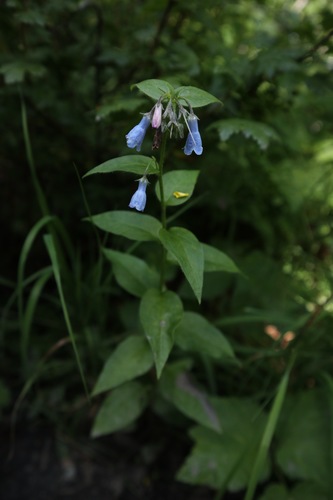


Tall Bluebell
mertensia paniculata
The Tall Bluebell (Mertensia paniculata), also known as the northern bluebell or tall lungwort, is a charming perennial wildflower native to the moist, cool regions of northern North America. This plant is a standout in woodland gardens and wild forests, forming lush green carpets that burst into vibrant color from late spring to mid-summer. One of its most captivating features is the color transition of its blossoms, which start as delicate pink buds before opening into clusters of brilliant, nodding blue bells. This beautiful display makes it a favorite sight for hikers and nature enthusiasts exploring northern trails.
Lebensraum: Found in moist, shaded environments such as boreal forests, riparian zones, and montane meadows.
Growing between 30 and 90 centimeters tall, this perennial herb features alternate, lance-shaped to ovate leaves that are covered in fine, short hairs, giving them a slightly rough texture. The star attraction is its terminal, drooping clusters of bell-shaped flowers, with each individual bloom measuring about 1 to 1.5 centimeters in length. The blossoms exhibit a striking color gradient, transitioning from soft pink when young to a deep lavender-blue as they mature, suspended gracefully from arching stems.
Kategorie
PflanzenSeltenheit
Common
Gefahr
1/5 · Sehr gering
Snaps
Mach den ersten Snap!
The common name lungwort arose because early herbalists believed the leaf patterns resembled lung tissue and used it to treat breathing disorders.
The dramatic pink-to-blue color change in the blossoms is caused by changes in the pH level of the cell sap as the flower matures.
The drooping, bell-like shape of the flowers protects the pollen from being washed away or damaged by heavy summer rains.
The flowers shift in color from pink to blue as they age, signaling to pollinators like bees which flowers are open and have the highest nectar rewards.
It survives harsh northern winters by dying back to a sturdy underground rhizome system, which allows for rapid growth in early spring as soon as snow melts.
Fine hairs on the leaves and stems help trap a thin layer of air, reducing moisture loss and protecting the plant from unexpected late-spring frosts.
As a photosynthetic organism, it produces its own food using sunlight, carbon dioxide, and water while absorbing essential minerals from moist soil.
Bombus affinis
Serves as an important source of nectar and pollen for bumblebees emerging in late spring.
Lepus americanus
The leaves and stems are occasionally grazed upon by hares during the spring and summer months.
Für dieses Objekt sind noch keine Merkmal-Badges vergeben.
Noch keine Alternativnamen vorhanden.
Sammlungen für dieses Objekt erscheinen hier, wenn weitere Themen hinzugefügt werden.
Gefahr
1/5 · Sehr gering
Noch keine besonderen Sicherheitshinweise.
Der einfachste Weg, Tall Bluebell zu bestimmen, ist die Verwendung der Naturführer-App Snappit.
30-90 cm
3-10 Jahre
As a photosynthetic organism, it produces its own food using sunlight, carbon dioxide, and water while absorbing essential minerals from moist soil.
Found in moist, shaded environments such as boreal forests, riparian zones, and montane meadows.
Zoome hinein, um Cluster aufzulösen und zu sehen, wo dieses Objekt fotografiert wurde.
Neueste Snaps erscheinen hier, wenn neue Beobachtungen hinzukommen.

Alaska, US
Hier kann man sehen Zwerg-Weidenröschen und Yellow Mountain-Avens.
Führer anzeigen →

Alaska, US
Hier kann man sehen Elch, Teufelskeule und Roter Holunder.
Führer anzeigen →

Alaska, US
Hier kann man sehen Elch, Amerikanisches Rothörnchen und Preiselbeere.
Führer anzeigen →