

Texas Skeleton Plant
lygodesmia texana
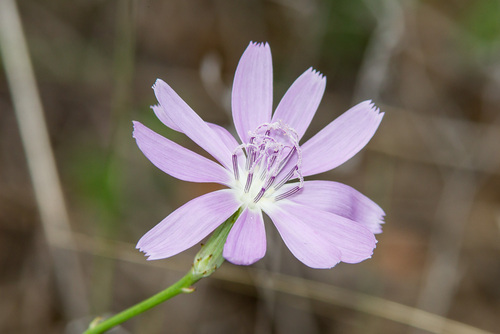
The Texas Skeleton Plant (Lygodesmia texana) is an intriguing native wildflower that seems to defy the harsh, dry conditions of the southern plains. Known for its sparse, seemingly leafless green stems that resemble a wire-like skeleton, this plant bursts into surprising beauty when its delicate, lavender-to-pink flower heads open. Each blossom features fringed, daisy-like petals that provide a stark, stunning contrast to the rugged, bare-looking branches beneath them. Historically valued for its resilience, this perennial species has adapted perfectly to limestone soils and rocky prairies. Its minimalist architecture minimizes water loss, making it a true survivor of the Texas heat. It is a favorite among local pollinators and native plant enthusiasts who appreciate its subtle, sculptural elegance in wild landscapes.
Lebensraum: Found in dry, open rocky prairies, limestone glades, and clay hillsides of the south-central United States.
This perennial herb grows up to 60 cm tall, characterized by slender, rigid, grey-green stems that branch out in a skeleton-like fashion. The leaves are extremely reduced, narrow, and often drop early, leaving the stems looking completely bare. At the tips of these wiry stems, solitary flower heads bloom, measuring about 3 to 5 cm across. The flowers are a striking pale purple, lavender, or pink, with distinctive flat, square-tipped petals that are finely fringed or tooth-edged at the ends, surrounding a cluster of dark purple anthers.
Kategorie
PflanzenSeltenheit
Common
Gefahr
1/5 · Sehr gering
Snaps
Mach den ersten Snap!
Despite its delicate appearance, the flowers only open for a few hours in the morning, closing up tightly as the heat of the afternoon sets in.
Like many members of the Asteraceae family, when any part of the stem is broken, it secretes a sticky white sap that native peoples historically chewed like gum.
The common name 'Skeleton Plant' comes from its leafless, wire-like appearance, which makes it look dead or skeletal until it suddenly blooms.
Its highly reduced, thin leaves and chlorophyll-rich green stems minimize surface area to prevent moisture loss while still allowing photosynthesis.
The plant contains a sticky, bitter milky sap that deters herbivores and seals wounds to prevent water loss and infection.
It possesses a tough, deep taproot system that anchors securely in rocky, calcareous soils, tapping into deep underground moisture reserves.
As a photoautotrophic plant, it produces its own energy through photosynthesis using sunlight, water, carbon dioxide, and essential soil minerals.
Bombus pensylvanicus
Provides nectar and pollen during the morning hours when its blooms are fully open.
Odocoileus virginianus
Occasionally grazes on the flowering stems despite the bitter, sticky latex sap.
Apis mellifera
Visits the pale purple flowers for nectar collection and assists in cross-pollination.
Für dieses Objekt sind noch keine Merkmal-Badges vergeben.
Noch keine Alternativnamen vorhanden.
Sammlungen für dieses Objekt erscheinen hier, wenn weitere Themen hinzugefügt werden.
Gefahr
1/5 · Sehr gering
Noch keine besonderen Sicherheitshinweise.
Der einfachste Weg, Texas Skeleton Plant zu bestimmen, ist die Verwendung der Naturführer-App Snappit.
30-60 cm
3-10 Jahre
As a photoautotrophic plant, it produces its own energy through photosynthesis using sunlight, water, carbon dioxide, and essential soil minerals.
Found in dry, open rocky prairies, limestone glades, and clay hillsides of the south-central United States.
Zoome hinein, um Cluster aufzulösen und zu sehen, wo dieses Objekt fotografiert wurde.
Neueste Snaps erscheinen hier, wenn neue Beobachtungen hinzukommen.




.jpg&width=800)



