

Thickleaf Groundcherry
physalis crassifolia
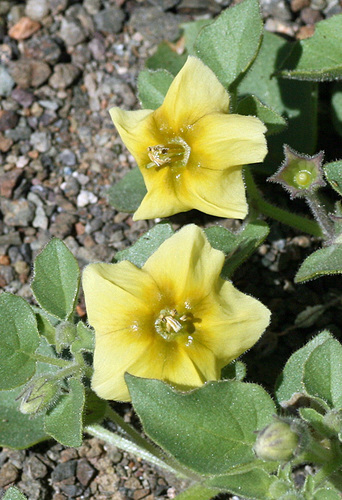
The Thickleaf Groundcherry is a resilient perennial herb native to the arid desert regions of the southwestern United States and northwestern Mexico. Belonging to the nightshade family, Solanaceae, this tough plant is perfectly adapted to survive in harsh, sun-drenched environments. It thrives in gravelly washes, rocky slopes, and canyon floors, often tucked under the partial shade of larger desert shrubs. One of its most fascinating features is the inflated, paper-like calyx that encloses its small, yellow fruit. This lantern structure acts as a protective shield against extreme desert heat and hungry predators. Once mature, the lightweight papery husk can easily catch the wind, helping to disperse seeds across the desert floor. Its small, bell-shaped flowers display bright yellow petals with greenish-brown centers, offering a cheerful burst of color in dry landscapes.
Lebensraum: Found in dry, rocky desert slopes, gravelly washes, and sandy canyon floors below 1,200 meters elevation.
Thickleaf Groundcherry grows as a low, spreading perennial mound, typically reaching 15 to 80 centimeters in height. Its leaves are thick, fleshy, ovate to triangular, and covered in fine, sticky glandular hairs that often catch blowing dust. The solitary, bell-shaped flowers are pale yellow to cream-colored, about 1 to 1.5 centimeters wide, with darker green or brownish markings inside the throat. After pollination, the calyx expands into a distinctive, hanging, 10-angled, bladder-like papery husk that resembles a miniature lantern, enclosing a small, fleshy green berry that matures to a pale yellow.
Kategorie
PflanzenSeltenheit
Common
Gefahr
1/5 · Sehr gering
Snaps
Mach den ersten Snap!
Indigenous peoples of the Southwest, including the Cahuilla, historically harvested the ripe yellow fruits of this groundcherry to eat fresh or cooked.
The botanical genus name Physalis is derived from the Greek word for 'bladder,' referencing the plant's inflated, balloon-like fruit husks.
The dry, papery husk surrounding the berry acts as a natural sail, allowing wind to tumble the fallen fruit across the desert floor to disperse its seeds.
The calyx inflates post-flowering to completely encase the developing fruit, protecting it from intense desert solar radiation, moisture loss, and herbivores.
Stems and leaves are coated in sticky, glandular trichomes that deter crawling insect pests and create a boundary layer of air to reduce water transpiration.
It can die back to its woody taproot during severe dry spells and rapidly regrow and flower following seasonal rain events.
As a photoautotrophic plant, it produces its own organic nutrients using sunlight, carbon dioxide, water, and essential soil minerals through photosynthesis.
Manduca sexta
The larvae of this moth feed heavily on the foliage of Solanaceae plants, including the thickleaf groundcherry.
Apis mellifera
A primary pollinator that visits the bell-shaped yellow flowers for nectar and pollen, facilitating plant reproduction.
Neotoma albigula
Feeds on the ripe fallen berries and occasionally uses the dried plant stalks to construct its desert middens.
Für dieses Objekt sind noch keine Merkmal-Badges vergeben.
Noch keine Alternativnamen vorhanden.
Sammlungen für dieses Objekt erscheinen hier, wenn weitere Themen hinzugefügt werden.
Gefahr
1/5 · Sehr gering
Noch keine besonderen Sicherheitshinweise.
Der einfachste Weg, Thickleaf Groundcherry zu bestimmen, ist die Verwendung der Naturführer-App Snappit.
15+ cm
2+ Jahre
As a photoautotrophic plant, it produces its own organic nutrients using sunlight, carbon dioxide, water, and essential soil minerals through photosynthesis.
Found in dry, rocky desert slopes, gravelly washes, and sandy canyon floors below 1,200 meters elevation.
Zoome hinein, um Cluster aufzulösen und zu sehen, wo dieses Objekt fotografiert wurde.
Neueste Snaps erscheinen hier, wenn neue Beobachtungen hinzukommen.
















