

Thin-Walled Maze Polypore
daedaleopsis confragosa
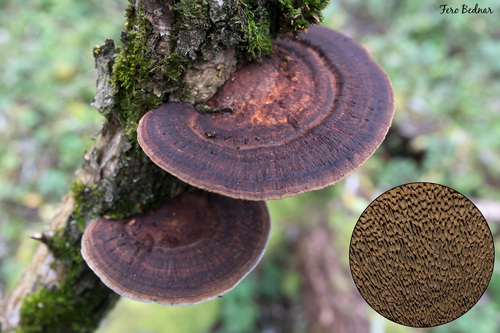
The Thin-Walled Maze Polypore (Daedaleopsis confragosa), also known as the blushing bracket, is an intriguing wood-decaying fungus that makes its home on dead or dying hardwood trees. Highly valued for its ecological role as a decomposer, this mushroom helps recycle vital nutrients back into the forest soil by breaking down tough wood fibers. What makes this polypore particularly captivating to nature enthusiasts is its incredibly variable under-surface, which can display pores resembling concentric circles, radiating slots, or intricate maze-like paths. It is also famous for its distinct bruising reaction, where its fresh cream-colored pores blush a deep reddish-brown when touched, offering an interactive experience for curious trail explorers.
Lebensraum: Typically found growing on decaying hardwood stumps, fallen logs, and dead branches in damp deciduous woodlands, particularly favoring willow, birch, and alder trees.
This bracket-like fungus typically develops a fan-shaped or semi-circular cap that measures between 5 to 15 centimeters in diameter. The upper surface is dry, slightly bumpy, and marked with distinctive concentric zones of color ranging from grayish-white to ochre, reddish-brown, and dark brown. Beneath the cap, the spore-bearing surface exhibits a unique pale cream to tan color featuring maze-like, elongated pores that turn reddish-brown when scratched or bruised.
Kategorie
PilzeSeltenheit
Common
Gefahr
1/5 · Sehr gering
Snaps
Mach den ersten Snap!
Because the tough, woody brackets do not easily rot, dried specimens can persist on trees for several years even after they have stopped producing spores.
The genus name 'Daedaleopsis' is a direct nod to Daedalus, the brilliant architect of Greek mythology who designed the Labyrinth of Crete, referring to the maze-like pores of the fungus.
While it is completely non-toxic, its tough, woody, and cork-like texture makes it entirely inedible for humans.
Produces specialized extracellular enzymes that systematically degrade both cellulose and highly resistant lignin in wood, causing white rot.
Undergoes a rapid chemical oxidation when injured, turning bruised pore areas reddish-brown to potentially deter small fungivores.
Alters its pore structures dynamically from round pores to slot-like gills depending on gravity, airflow, and localized moisture levels.
As a saprotrophic fungus, it obtains all of its nutrition by decaying the dead wood of deciduous broadleaf trees.
Betula pendula
Acts as a primary saprotrophic decomposer of fallen logs and branches of the Silver Birch.
Cis boleti
The bracket body serves as both shelter and food source for the larvae of minute tree-fungus beetles.
Für dieses Objekt sind noch keine Merkmal-Badges vergeben.
Noch keine Alternativnamen vorhanden.
Sammlungen für dieses Objekt erscheinen hier, wenn weitere Themen hinzugefügt werden.
Gefahr
1/5 · Sehr gering
Noch keine besonderen Sicherheitshinweise.
Der einfachste Weg, Thin-Walled Maze Polypore zu bestimmen, ist die Verwendung der Naturführer-App Snappit.
5-15 cm
1-2 Jahre
As a saprotrophic fungus, it obtains all of its nutrition by decaying the dead wood of deciduous broadleaf trees.
Typically found growing on decaying hardwood stumps, fallen logs, and dead branches in damp deciduous woodlands, particularly favoring willow, birch, and alder trees.
Zoome hinein, um Cluster aufzulösen und zu sehen, wo dieses Objekt fotografiert wurde.
Neueste Snaps erscheinen hier, wenn neue Beobachtungen hinzukommen.