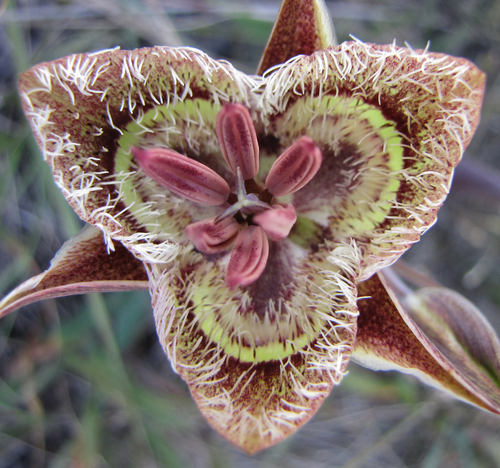


Tiburon Mariposa Lily
calochortus tiburonensis
The Tiburon Mariposa Lily, Calochortus tiburonensis, is a captivating and exceedingly rare perennial herb, endemic to the serpentine soils of Ring Mountain Preserve in Marin County, California. This striking member of the lily family is a botanical treasure, known for its unique adaptations to its harsh, nutrient-poor serpentine habitat. Its discovery in 1972 highlighted the exceptional biodiversity found within this specific ecological niche, making it a critical species for conservation efforts. The lily's survival is intimately linked to the preservation of its specialized habitat, offering a poignant example of the delicate balance within unique ecosystems and the vulnerability of highly specialized species to habitat loss and disturbance.
Lebensraum: The Tiburon Mariposa Lily is exclusively found on the rocky, nutrient-poor serpentine soils of Ring Mountain Preserve in Marin County, California, often in grassland or open shrubland environments.
This Mariposa Lily produces a single, upright stem, typically growing 10-50 cm tall, which may branch. The bell-shaped flowers are borne at the stem's apex, usually 1-3 per plant, sometimes more. Each flower displays three sepals and three petals, with the petals typically yellowish-green to brownish-purple, often adorned with darker, intricate streaks or spots, and densely covered in fine, whitish hairs on the inside, particularly towards the base. A prominent dark nectary gland is visible at the base of each petal. The basal leaves are grass-like, linear, and often wither by the time the plant flowers.
Kategorie
PflanzenSeltenheit
Common
Gefahr
1/5 · Sehr gering
Snaps
Mach den ersten Snap!
Discovered relatively recently in 1972 by botanist Alva Potts, highlighting how unique species can remain hidden even in developed areas.
It is considered a "geophyte," meaning it stores its energy in an underground bulb, allowing it to survive periods of drought and emerge anew each spring.
Its name "Mariposa Lily" comes from the Spanish word for "butterfly," referring to the often intricate, wing-like patterns on the petals of many Calochortus species.
The Tiburon Mariposa Lily thrives on serpentine soils, which are derived from oceanic crust and are characterized by low calcium, high magnesium, and elevated levels of heavy metals like nickel and chromium, making them toxic to most plants.
This lily has evolved to thrive exclusively on serpentine soils, which are toxic to most other plants due to high concentrations of heavy metals and low levels of essential nutrients like calcium. This adaptation limits competition but also restricts its geographic range.
As a geophyte, it possesses an underground bulb that allows it to survive the dry California summers by storing water and nutrients, enabling it to emerge and flower during the spring when conditions are more favorable.
Its unique flower morphology, color, and hairy interior suggest co-evolution with specific native insect pollinators, which are attracted to its nectaries and play a crucial role in its reproductive success within its isolated habitat.
As an autotrophic plant, the Tiburon Mariposa Lily produces its own food through photosynthesis, utilizing sunlight, carbon dioxide from the atmosphere, and water and minerals absorbed from its specialized serpentine soil habitat.
Hylaeus spp.
Essential pollinator for flower reproduction.
Peromyscus maniculatus
Grazes on plant foliage, potentially impacting growth.
Festuca californica
Native grass that competes for resources in the same serpentine grassland habitat.
Für dieses Objekt sind noch keine Merkmal-Badges vergeben.
Noch keine Alternativnamen vorhanden.
Sammlungen für dieses Objekt erscheinen hier, wenn weitere Themen hinzugefügt werden.
Gefahr
1/5 · Sehr gering
Noch keine besonderen Sicherheitshinweise.
Der einfachste Weg, Tiburon Mariposa Lily zu bestimmen, ist die Verwendung der Naturführer-App Snappit.
10-50 cm
5-20 Jahre
As an autotrophic plant, the Tiburon Mariposa Lily produces its own food through photosynthesis, utilizing sunlight, carbon dioxide from the atmosphere, and water and minerals absorbed from its specialized serpentine soil habitat.
The Tiburon Mariposa Lily is exclusively found on the rocky, nutrient-poor serpentine soils of Ring Mountain Preserve in Marin County, California, often in grassland or open shrubland environments.
Photosynthesis And Nutrient Absorption
50-500
15-60 Tage
Zoome hinein, um Cluster aufzulösen und zu sehen, wo dieses Objekt fotografiert wurde.
Neueste Snaps erscheinen hier, wenn neue Beobachtungen hinzukommen.
















