

Tolmie'S Pussy Ears
calochortus tolmiei
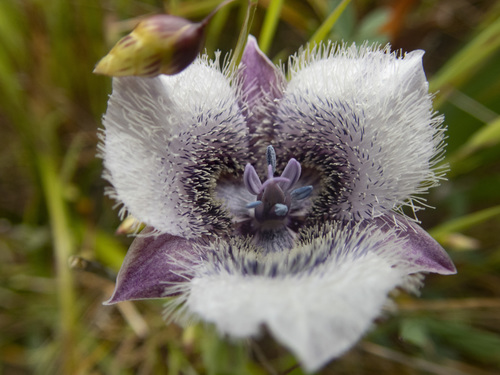
Tolmie's Pussy Ears (Calochortus tolmiei) is an enchanting perennial wildflower native to the West Coast of North America. Renowned for its unique, fuzzy blossoms, this member of the lily family (Liliaceae) brightens open woodlands, grasslands, and rocky slopes from spring to early summer. The plant arises from a deep underground bulb, producing a single, grass-like leaf and a striking flower stalk that carries one to several delicate blooms. What makes Tolmie's Pussy Ears so captivating is the dense coating of fine, soft hairs on its inner petals, giving them an uncanny resemblance to the fuzzy ears of a cat. This endearing adaptation is not just for show; it serves vital ecological roles, such as guiding native pollinators to the flower's nectar. Highly valued in native plant gardens and wild ecosystems alike, this resilient species demonstrates a remarkable ability to survive dry summer conditions by retreating into dormancy beneath the soil.
Lebensraum: Found in open woodlands, meadows, and rocky slopes, typically in well-drained soils along the Pacific Coast of North America.
A low-growing plant standing 10 to 40 centimeters tall, Tolmie's Pussy Ears is characterized by its nodding, bell-shaped to star-shaped flowers. Each blossom consists of three lance-shaped green sepals and three broad, creamy-white to pale purple petals. The defining feature is the interior of the petals, which are densely fringed with long, soft, white or purple-tinged hairs. A single long, flat, bluish-green basal leaf emerges from the ground, often exceeding the height of the flower stem itself.
Kategorie
PflanzenSeltenheit
Common
Gefahr
1/5 · Sehr gering
Snaps
Mach den ersten Snap!
Because of their hairy texture, the petals can trap morning dew, which may help the flower maintain humidity in dry microclimates.
Indigenous peoples of the Pacific Northwest, such as the Calapooia, gathered the bulbs of Tolmie's Pussy Ears to eat raw or cooked as a sweet, nutritious food source.
The genus name 'Calochortus' is derived from Greek, meaning 'beautiful grass', referring to the plant's elegant grass-like leaves and stunning flowers.
The dense, soft hairs on the inner petals act as a tactile guide for pollinators and help protect the delicate reproductive organs from moisture and cold temperatures.
Survives harsh, dry summer droughts by storing energy in an underground bulb and dying back completely, emerging only when winter rains return.
Forms mutualistic relationships with underground mycorrhizal fungi to enhance its uptake of water and essential nutrients in nutrient-poor soils.
As a photosynthetic autotroph, Tolmie's Pussy Ears produces its own food using sunlight, carbon dioxide, and water, supplemented by nutrients absorbed from the soil.
Altersunterschiede: Seedlings rely on energy stored in the seed endosperm before developing leaves for photosynthesis and a bulb for nutrient storage.
Bombus vosnesenskii
Acts as a primary pollinator, visiting the hairy flowers to collect nectar and pollen.
Odocoileus hemionus
Occasionally grazes on the tender spring foliage and flower buds of the plant.
Glomus intraradices
Provides vital soil nutrients and water to the plant's roots in exchange for photosynthetic sugars.
Für dieses Objekt sind noch keine Merkmal-Badges vergeben.
Noch keine Alternativnamen vorhanden.
Sammlungen für dieses Objekt erscheinen hier, wenn weitere Themen hinzugefügt werden.
Gefahr
1/5 · Sehr gering
Noch keine besonderen Sicherheitshinweise.
Der einfachste Weg, Tolmie'S Pussy Ears zu bestimmen, ist die Verwendung der Naturführer-App Snappit.
10-40 cm
5-15 Jahre
As a photosynthetic autotroph, Tolmie's Pussy Ears produces its own food using sunlight, carbon dioxide, and water, supplemented by nutrients absorbed from the soil.
Found in open woodlands, meadows, and rocky slopes, typically in well-drained soils along the Pacific Coast of North America.
Photosynthesis
Zoome hinein, um Cluster aufzulösen und zu sehen, wo dieses Objekt fotografiert wurde.
Neueste Snaps erscheinen hier, wenn neue Beobachtungen hinzukommen.













_1_(24790682337).jpg&width=800)



.jpg&width=800)