

Trembling Crust
merulius tremellosus
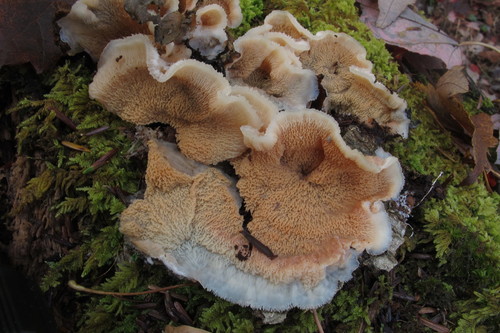
The Trembling Crust (Merulius tremellosus) is a fascinating wood-decaying fungus that brings a gelatinous charm to forest ecosystems. Growing on decaying hardwood and softwood logs, this bracket-like or crust-like fungus is famous for its semi-translucent, rubbery texture that wiggles slightly when touched. It acts as an essential saprotroph, actively breaking down complex wood compounds like lignin and cellulose, which recycles vital nutrients back into the forest soil. Often found clustered in tiers, it transitions from a flat crust to a wavy, shelf-like bracket. It is a wonderful example of the diverse forms fungi take to colonize fallen wood, providing both visual interest and ecological value.
Lebensraum: Found primarily on decomposing deciduous hardwood and occasionally coniferous logs, stumps, and fallen branches in moist, shaded woodlands.
Merulius tremellosus is easily recognized by its fan-shaped or fused shelf-like structure, featuring a hairy, white to pale cream upper surface with a distinctly pinkish, orange, or flesh-colored underside. The spore-bearing lower surface is wrinkled, pore-like, or shallowly radial-veined, giving it a gelatinous, brain-like, or net-like appearance. Individual brackets typically measure 2 to 8 cm wide, often growing in overlapping, wavy rows. When fresh, the flesh is moist and flexible, turning rigid and brittle when dry.
Kategorie
PilzeSeltenheit
Common
Gefahr
1/5 · Sehr gering
Snaps
Mach den ersten Snap!
The common name 'Trembling Crust' refers to the gelatinous, jelly-like texture of the fresh fruiting bodies, which quiver when touched.
This fungus plays an essential role in forest nutrient cycling by converting hard wood debris into organic soil matter.
While it looks like a typical shelf polypore, it is actually more closely related to crust fungi and possesses a wrinkled, veined spore-bearing surface.
Produces specialized enzymes that allow it to break down complex lignin and cellulose structures, contributing to white rot decay.
Its rubbery, gelatinous matrix helps it retain essential moisture during dry spells, surviving sudden humidity drops.
Can grow flat against the wood surface or peel back to form shelves, optimizing spore release based on substrate orientation.
As a saprotrophic fungus, it obtains nutrients by decomposing dead and decaying woody plant matter, primarily hardwoods.
Triplax thoracica
Feeds on the gelatinous fruiting bodies of the Trembling Crust.
Trametes versicolor
Competes for space and resources on decaying hardwood logs.
Für dieses Objekt sind noch keine Merkmal-Badges vergeben.
Noch keine Alternativnamen vorhanden.
Sammlungen für dieses Objekt erscheinen hier, wenn weitere Themen hinzugefügt werden.
Gefahr
1/5 · Sehr gering
Noch keine besonderen Sicherheitshinweise.
Der einfachste Weg, Trembling Crust zu bestimmen, ist die Verwendung der Naturführer-App Snappit.
2+ cm
As a saprotrophic fungus, it obtains nutrients by decomposing dead and decaying woody plant matter, primarily hardwoods.
Found primarily on decomposing deciduous hardwood and occasionally coniferous logs, stumps, and fallen branches in moist, shaded woodlands.
Zoome hinein, um Cluster aufzulösen und zu sehen, wo dieses Objekt fotografiert wurde.
Neueste Snaps erscheinen hier, wenn neue Beobachtungen hinzukommen.














