

Tropical Finger-Grass
digitaria ciliaris
Tropical Finger-Grass, scientifically known as Digitaria ciliaris, is a warm-season annual grass that aggressively colonizes open, disturbed environments. Often recognized as a stubborn lawn weed or agricultural nuisance under names like 'southern crabgrass,' this species is a master of survival in tropical and subtropical regions worldwide. It thrives in punishing heat and poor soils where other plants might wither, thanks to its specialized C4 photosynthetic pathway. The plant features sprawling, mat-forming stems that root wherever their joints touch the ground, allowing it to rapidly conquer bare patches of soil. Despite its reputation as an uninvited guest in manicured gardens and crop fields, Tropical Finger-Grass plays a notable ecological role as a pioneer species. It stabilizes loose, exposed soil to prevent erosion and provides a quick source of forage for grazing animals. Its sheer resilience and global distribution make it a fascinating example of evolutionary adaptation to human-altered landscapes, perfectly tuned to exploit the sunny, disturbed habitats we create.
Lebensraum: Found in sunny, disturbed soils, agricultural fields, lawns, and roadsides throughout tropical, subtropical, and warm-temperate regions.
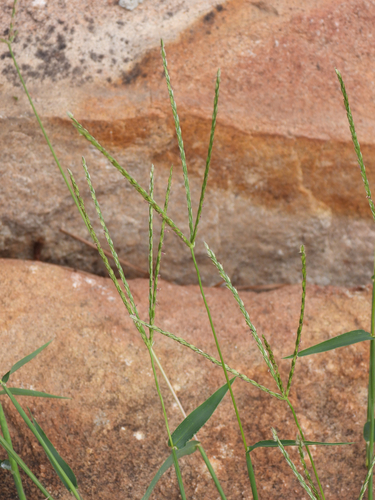
This sprawling grass typically grows close to the ground, producing branching, purplish-green stems that bend and root at their lower nodes. The leaf blades are flat, linear, and often covered in fine, silky hairs near the base and sheath, giving the plant a somewhat fuzzy appearance close up. Its most distinguishing feature is its inflorescence: a terminal cluster of 2 to 10 slender, finger-like spikes (racemes) that radiate outward from the tip of the stem, resembling a bird's foot. These 'fingers' are lined with tiny, neatly paired, bristly spikelets that mature into seeds.
Kategorie
PflanzenSeltenheit
Common
Gefahr
1/5 · Sehr gering
Snaps
Mach den ersten Snap!
A single plant can produce up to 10,000 seeds in a single growing season, allowing it to quickly dominate exposed patches of soil.
Because it uses the C4 photosynthetic pathway, Tropical Finger-Grass can continue to thrive and grow in mid-summer temperatures that cause typical lawn grasses to go dormant.
Despite being the bane of gardeners, it is highly valued by some farmers in the tropics as a fast-growing, nutritious pasture grass for cattle and sheep.
The genus name 'Digitaria' comes from the Latin word 'digitus', meaning finger, which perfectly describes the plant's hand-like flower clusters.
Utilizes a highly efficient C4 carbon fixation pathway, allowing the plant to photosynthesize effectively and conserve water during intense heat and drought.
Possesses stems (culms) that grow laterally across the ground and sprout new roots wherever a node touches the soil, enabling rapid, mat-like spread.
Produces thousands of tiny seeds per plant that easily disperse via wind, water, or animal activity, ensuring a high germination rate in bare soils.
As a photoautotroph, it generates its own food using sunlight, carbon dioxide, and water.
Bos taurus
Provides forage and is actively grazed by domestic and wild herbivores.
Zea mays
Competes for soil nutrients, water, and sunlight in agricultural settings.
Spodoptera frugiperda
Acts as an alternative host plant for the larvae of this major agricultural pest.
Für dieses Objekt sind noch keine Merkmal-Badges vergeben.
Noch keine Alternativnamen vorhanden.
Sammlungen für dieses Objekt erscheinen hier, wenn weitere Themen hinzugefügt werden.
Gefahr
1/5 · Sehr gering
Noch keine besonderen Sicherheitshinweise.
Der einfachste Weg, Tropical Finger-Grass zu bestimmen, ist die Verwendung der Naturführer-App Snappit.
10-100 cm
0-1 Jahre
As a photoautotroph, it generates its own food using sunlight, carbon dioxide, and water.
Found in sunny, disturbed soils, agricultural fields, lawns, and roadsides throughout tropical, subtropical, and warm-temperate regions.
Photosynthesis
1000-10000
5-14 Tage
Zoome hinein, um Cluster aufzulösen und zu sehen, wo dieses Objekt fotografiert wurde.
Neueste Snaps erscheinen hier, wenn neue Beobachtungen hinzukommen.