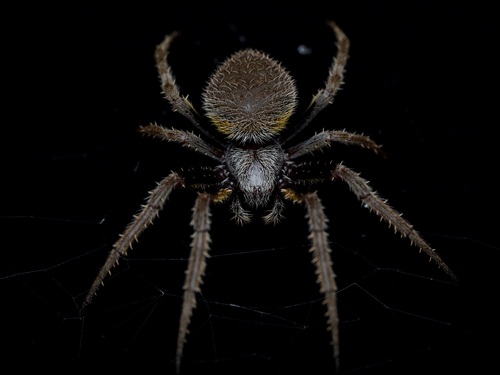


Tropical Orbweaver
eriophora ravilla
The Tropical Orbweaver (Eriophora ravilla) is an engaging and highly adaptable nocturnal spider found throughout the warmer, humid regions of the Americas. Renowned for its impressive web-building skills, this species weaves massive, circular orb webs at dusk, which it uses to capture flying insects overnight. One of the most intriguing aspects of the Tropical Orbweaver is its extreme color and pattern polymorphism; individuals can look remarkably different from one another, ranging from bright greens and yellows to dull browns and grays, sometimes featuring a distinct white or yellow stripe down the abdomen. As dawn approaches, these industrious spiders typically consume their own webs to recycle the valuable proteins, retreating to hide under nearby leaves or bark during the day. This behavior makes them spectacular nocturnal subjects for nature enthusiasts. Encountering one in a garden or forest edge offers a wonderful glimpse into the intricate and efficient world of arachnid engineering.
Lebensraum: Typically found in warm, humid environments such as subtropical forests, citrus groves, gardens, and forest edges, where they can easily suspend webs between trees or shrubs.
The Tropical Orbweaver is a medium-to-large spider characterized by a bulbous, slightly teardrop-shaped abdomen and a relatively flat, hairy cephalothorax. Due to high polymorphism, their coloration varies wildly: some are uniform pale green, while others are mottled gray, reddish-brown, or cream-colored, often with a prominent pale green or yellow patch or longitudinal stripe on the dorsum. Females are significantly larger than males, with a body length of 1.2 to 2.4 cm, while males rarely exceed 1.0 cm. Their legs are robust, typically covered in fine spines and alternating dark and light bands.
Kategorie
InvertebrateSeltenheit
Common
Gefahr
1/5 · Sehr gering
Snaps
Mach den ersten Snap!
During the daytime, they tuck their legs tightly against their bodies while resting on a twig or leaf, perfectly mimicking a bud, leaf scar, or bird dropping.
The species exhibits extreme color polymorphism; two spiders born from the same egg sac can look like entirely different species.
They are known to consume their entire web every morning to recycle the silk proteins, leaving almost no trace of their presence during the day.
The spider consumes its silk web every morning to conserve protein and moisture, rebuilding a fresh web at dusk.
Individuals display highly variable color patterns, ranging from bright green to brown, helping them blend into different microhabitats.
Highly sensitive slit sensilla on their legs detect minute vibrations in the web, allowing them to pinpoint trapped prey in complete darkness.
A nocturnal predator that feeds on flying insects intercepted by its sticky, aerial orb web constructed at twilight.
Altersunterschiede: Juveniles eat smaller insects like fruit flies and gnats, while mature females tackle much larger beetles and moths.
Chalybion californicum
The Blue Mud Wasp hunts and paralyzes Tropical Orbweavers to provision its mud nests with food for its developing larvae.
Anolis carolinensis
The Green Anole actively hunts spiders, including the Tropical Orbweaver, when they are found resting in foliage during the day.
Spodoptera frugiperda
The Tropical Orbweaver captures and consumes nocturnal moths like the Fall Armyworm Moth in its large sticky web.
Für dieses Objekt sind noch keine Merkmal-Badges vergeben.
Noch keine Alternativnamen vorhanden.
Sammlungen für dieses Objekt erscheinen hier, wenn weitere Themen hinzugefügt werden.
Gefahr
1/5 · Sehr gering
Noch keine besonderen Sicherheitshinweise.
Der einfachste Weg, Tropical Orbweaver zu bestimmen, ist die Verwendung der Naturführer-App Snappit.
1+ cm
0.0001+ kg
1+ Jahre
A nocturnal predator that feeds on flying insects intercepted by its sticky, aerial orb web constructed at twilight.
Typically found in warm, humid environments such as subtropical forests, citrus groves, gardens, and forest edges, where they can easily suspend webs between trees or shrubs.
Ambush
100+
Zoome hinein, um Cluster aufzulösen und zu sehen, wo dieses Objekt fotografiert wurde.
Neueste Snaps erscheinen hier, wenn neue Beobachtungen hinzukommen.