

Tulip Morel
morchella diminutiva
The Tulip Morel (Morchella diminutiva) is a highly sought-after, spring-fruiting fungus native to the deciduous forests of eastern North America. Renowned among wild mushroom foragers, this small but exquisite morel is deeply tied to the awakening of the forest floor after the winter cold. It shares a special, complex ecological relationship with specific hardwood trees, particularly the tulip tree, from which it derives its common name. Growing solitarily or in small scattered groups, these fungi play a vital role in nutrient cycling within their native ecosystems. Uniquely distinguished by its small stature and beautifully honeycombed cap, it is a true treasure of springtime woodland wanders. Foragers and mycologists alike celebrate its annual appearance, which signals the peak of spring. Though small, its distinct appearance and rich culinary value make it one of the most beloved and celebrated fungi of the forest.
Lebensraum: Typically found on the ground in deciduous forests, particularly in moist soils surrounding the roots of tulip trees, ash, and elms.
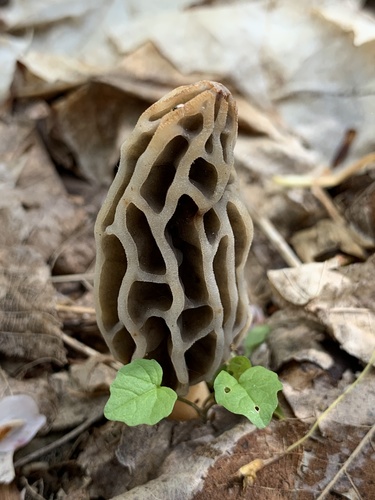
The Tulip Morel is characterized by a small, narrowly conical to egg-shaped cap with a distinct honeycomb pattern of pits and ridges. The cap ranges from 2 to 5 cm in height, featuring yellowish-brown to greyish-brown ridges that darken with age, contrasting with lighter grayish-yellow pits. The entire mushroom stands about 4 to 10 cm tall, supported by a fragile, hollow, whitish to cream-colored stem that typically tapers slightly toward the top.
Kategorie
PilzeSeltenheit
Common
Gefahr
1/5 · Sehr gering
Snaps
Mach den ersten Snap!
Despite their delicious reputation, raw Tulip Morels contain mild toxins and must always be cooked thoroughly before eating.
Its scientific name 'diminutiva' refers to its smaller size compared to other common yellow morels.
The Tulip Morel is known as a 'blond' morel due to its light coloration compared to black morels.
Forms complex mutualistic relationships with the root systems of specific hardwood trees to exchange nutrients.
Utilizes microscopic pressure-driven mechanisms within its asci to forcibly eject spores into the wind for dispersal.
Creates hardened, underground survival structures that can withstand freezing winter conditions before fruiting in the spring.
Absorbs nutrients from decaying organic matter in the soil and exchanges vital elements with host tree roots through mycorrhizal associations.
Liriodendron tulipifera
Forms a mutualistic mycorrhizal relationship where the fungus exchanges soil minerals for host carbon.
Mycetophila fungorum
Feeds on the developing fruiting bodies of the morel.
Für dieses Objekt sind noch keine Merkmal-Badges vergeben.
Noch keine Alternativnamen vorhanden.
Sammlungen für dieses Objekt erscheinen hier, wenn weitere Themen hinzugefügt werden.
Gefahr
1/5 · Sehr gering
Noch keine besonderen Sicherheitshinweise.
Der einfachste Weg, Tulip Morel zu bestimmen, ist die Verwendung der Naturführer-App Snappit.
4-10 cm
0.005-0.03 kg
Absorbs nutrients from decaying organic matter in the soil and exchanges vital elements with host tree roots through mycorrhizal associations.
Typically found on the ground in deciduous forests, particularly in moist soils surrounding the roots of tulip trees, ash, and elms.
Foraging
Zoome hinein, um Cluster aufzulösen und zu sehen, wo dieses Objekt fotografiert wurde.
Neueste Snaps erscheinen hier, wenn neue Beobachtungen hinzukommen.









_Fayod_33118_crop.jpg&width=800)
.jpg&width=800)