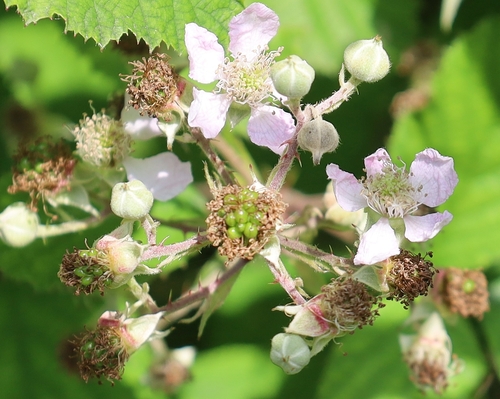


Twice-Leaved Blackberry
rubus bifrons
The Twice-Leaved Blackberry (Rubus bifrons) is a vigorous, sprawling perennial shrub known for its arching canes and tasty, deep-purple to black fruits. Native to Europe but naturalized in many temperate regions worldwide, this resilient plant thrives in disturbed environments, forming dense, thorny thickets. These thickets provide excellent cover and nesting sites for small birds and mammals, though the plant's aggressive growth can sometimes overwhelm native vegetation. During the warm months, its showy blossoms serve as a rich nectar source for a variety of native pollinators, cementing its role as a key wildlife supporter.
Lebensraum: Typically found in disturbed sites, forest edges, riparian zones, old fields, and along roadsides in moist, well-drained soils.
This robust bramble features stout, arching canes that typically reach lengths of 1 to 6 meters, heavily armed with sharp, backward-curved prickles. Its palmately compound leaves are uniquely two-toned, displaying a smooth, dark green surface on top and a contrasting, felt-like, grayish-white underside. In late spring and summer, it produces clusters of five-petaled flowers ranging from white to light pink, which eventually develop into clusters of glossy, aggregate drupelets that turn black when fully ripe.
Kategorie
PflanzenSeltenheit
Common
Gefahr
1/5 · Sehr gering
Snaps
Mach den ersten Snap!
A single mature thicket of these blackberries can generate thousands of seeds annually, which can remain dormant in the soil for several years waiting for sunlight.
Historically, dense, thorny brambles like this species were purposefully planted around homesteads to serve as organic, impenetrable security fences.
The species name 'bifrons' literally translates to 'two-faced' or 'two-fronted,' describing the starkly contrasting dark green and bright white sides of its leaves.
The dense white hairs on the leaf undersides reflect excess solar radiation and reduce water loss through transpiration during hot days.
When the tips of its long, arching canes touch moist soil, they can quickly generate roots to establish new, independent clonal plants.
Sharp, downward-curving prickles prevent herbivores from easily feeding on the foliage and assist the canes in climbing over surrounding vegetation.
This plant produces its own organic compounds using sunlight, water, and carbon dioxide through photosynthesis, while absorbing key minerals through its root system.
Apis mellifera
The flowers provide an abundant source of nectar and pollen for foraging honey bees in exchange for pollination.
Turdus migratorius
The ripe blackberries are eaten by robins, which then disperse the seeds throughout the landscape.
Oberea bimaculata
Larvae of this beetle tunnel into the woody canes, feeding on the pith and weakening the stalks.
Für dieses Objekt sind noch keine Merkmal-Badges vergeben.
Sammlungen für dieses Objekt erscheinen hier, wenn weitere Themen hinzugefügt werden.
Gefahr
1/5 · Sehr gering
Noch keine besonderen Sicherheitshinweise.
Der einfachste Weg, Twice-Leaved Blackberry zu bestimmen, ist die Verwendung der Naturführer-App Snappit.
100-600 cm
1-15 kg
5-25 Jahre
This plant produces its own organic compounds using sunlight, water, and carbon dioxide through photosynthesis, while absorbing key minerals through its root system.
Typically found in disturbed sites, forest edges, riparian zones, old fields, and along roadsides in moist, well-drained soils.
Zoome hinein, um Cluster aufzulösen und zu sehen, wo dieses Objekt fotografiert wurde.
Neueste Snaps erscheinen hier, wenn neue Beobachtungen hinzukommen.