

Two-Lined Swamp Fly
anasimyia bilinearis
The Two-Lined Swamp Fly (Anasimyia bilinearis) is a charming and specialized species of hoverfly primarily found in wetland ecosystems across North America. Often overlooked due to their small size, these insects are vital indicators of healthy wetland environments and play dual ecological roles: as larvae, they act as aquatic detritivores, and as adults, they transition into diligent pollinators. Their bright, contrasting patterns not only help them blend into marshy vegetation but also mimic stinging insects like bees and wasps to deter potential predators. Observing these flies reveals their incredible aerial agility, typical of the family Syrphidae. They can hover perfectly in place above stagnant water or swamp plants, only to dart away in the blink of an eye. For nature enthusiasts, spotting a Two-Lined Swamp Fly is a delightful reminder of the complex, hidden life thriving within marshy reeds and sedges.
Lebensraum: Typically found in wetlands, fens, bogs, and marshy margins of ponds with emergent vegetation like cattails and sedges.
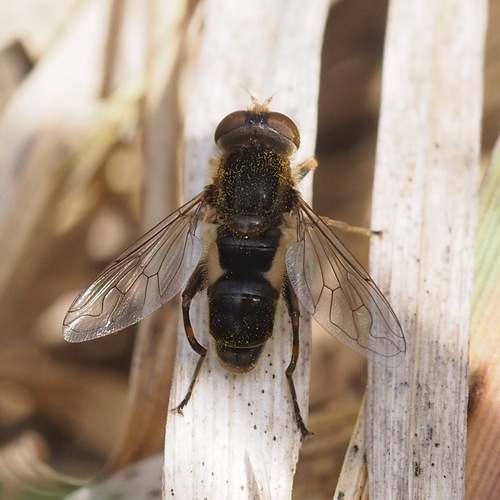
The Two-Lined Swamp Fly is a small insect, typically measuring under one centimeter in length. It features a distinctive dark thorax adorned with two prominent, pale longitudinal stripes and a black-and-yellow patterned abdomen. Its face has a pronounced snout-like projection, and its large compound eyes are characteristic of hoverflies. The wings are clear with subtle veins, and when resting, they are often held flat over the back. Its legs are relatively short and dark with yellowish markings near the joints.
Kategorie
InsektenSeltenheit
Common
Gefahr
1/5 · Sehr gering
Snaps
Mach den ersten Snap!
Like many hoverflies, they are excellent mimics, imitating bees and wasps to scare off predators while being completely harmless.
The larvae of this genus are called 'rat-tailed maggots' because of a long, telescopic breathing tube that acts as a snorkel.
Their species name, 'bilinearis', refers to the two distinct light-colored stripes running down their dark thorax.
Utilizes advanced wing mechanics to remain perfectly stationary in mid-air to assess its surroundings or locate flowers.
Its bold black and yellow abdomen mimics the warning coloration of stinging wasps to deter avian predators.
In its larval stage, it uses a telescopic breathing tube to respire while submerged in oxygen-depleted mud.
Adults feed on nectar and pollen from wetland plants, while their aquatic larvae consume decaying organic matter and microbes.
Altersunterschiede: Larvae are aquatic filter-feeding detritivores in organic mud, whereas adults are terrestrial pollinators feeding exclusively on nectar and pollen.
Typha latifolia
The larvae live and feed among decaying vegetation stalks in wetland habitats.
Geothlypis trichas
Adults are preyed upon by wetland-dwelling insectivorous birds.
Caltha palustris
Adults pollinate various wetland flowers while feeding on nectar.
Für dieses Objekt sind noch keine Merkmal-Badges vergeben.
Noch keine Alternativnamen vorhanden.
Sammlungen für dieses Objekt erscheinen hier, wenn weitere Themen hinzugefügt werden.
Gefahr
1/5 · Sehr gering
Noch keine besonderen Sicherheitshinweise.
Der einfachste Weg, Two-Lined Swamp Fly zu bestimmen, ist die Verwendung der Naturführer-App Snappit.
1 cm
1-2 cm
0.00001-0.00003 kg
15 km/h
Adults feed on nectar and pollen from wetland plants, while their aquatic larvae consume decaying organic matter and microbes.
Typically found in wetlands, fens, bogs, and marshy margins of ponds with emergent vegetation like cattails and sedges.
Foraging
Zoome hinein, um Cluster aufzulösen und zu sehen, wo dieses Objekt fotografiert wurde.
Neueste Snaps erscheinen hier, wenn neue Beobachtungen hinzukommen.



.jpg&width=800)




_(cropped).jpg&width=800)






