

Twoflower Violet
viola biflora
The Twoflower Violet is a charming perennial wildflower that brings a splash of cheerful, bright yellow to alpine and subalpine meadows across the Northern Hemisphere. True to its name, this delicate mountain plant often bears its blossoms in distinct pairs on thin, upright stems. Unlike many of its purple-flowered relatives in the Viola genus, this species specializes in cold, damp mountain environments, thriving where few other flowers can cope with the short growing season.
Lebensraum: Typically found in moist, shaded alpine and subalpine habitats, including damp rocky crevices, stream banks, coniferous forest edges, and wet meadows.
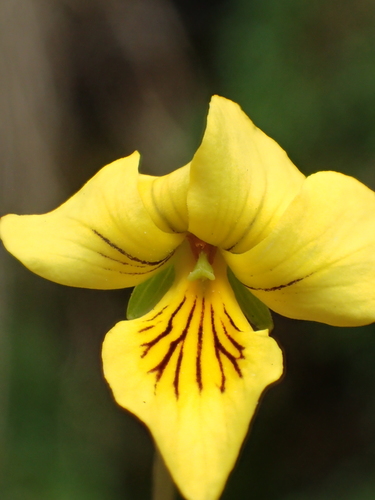
Growing between 5 to 20 cm in height, the Twoflower Violet is easily identified by its golden-yellow flowers, each measuring about 1.5 cm across and adorned with delicate brownish-purple stripes on the lowest petal. Its soft-green leaves are heart- to kidney-shaped with slightly scalloped edges, growing alternately along a slender, semi-translucent stem. The flowers typically nod downward slightly, often appearing in close-knit pairs.
Kategorie
PflanzenSeltenheit
Common
Gefahr
1/5 · Sehr gering
Snaps
Mach den ersten Snap!
Its self-pollinating flowers near the soil never open, acting as a clever reproductive backup if freezing mountain weather keeps pollinators away.
The species name 'biflora' is Latin for 'two-flowered', pointing to the plant's unique habit of producing flowers in pairs.
While most violets are purple or blue, this species stands out in its alpine habitat with its vivid bright-yellow coloration.
The delicate dark veins on the lower petals act as high-contrast guide paths for insect pollinators, directing them straight to the nectar source.
It produces both typical showy flowers for cross-pollination and tiny, closed self-pollinating flowers near the ground to guarantee seed production in harsh weather.
The seeds develop lipid-rich appendages called elaiosomes that entice ants to carry and plant the seeds safely underground.
As a photosynthetic plant, it generates its own energy from sunlight, water, and carbon dioxide while absorbing essential minerals through its roots.
Formica rufa
Ants collect and disperse the nutrient-rich seeds, facilitating the plant's spread in alpine rocky terrain.
Boloria thore
The foliage serves as an essential food source for the caterpillars of the alpine-dwelling Thor's Fritillary butterfly.
Bombus jonellus
Bumblebees visit the yellow blooms in early summer to extract nectar, performing vital pollination in the process.
Für dieses Objekt sind noch keine Merkmal-Badges vergeben.
Noch keine Alternativnamen vorhanden.
Sammlungen für dieses Objekt erscheinen hier, wenn weitere Themen hinzugefügt werden.
Gefahr
1/5 · Sehr gering
Noch keine besonderen Sicherheitshinweise.
Der einfachste Weg, Twoflower Violet zu bestimmen, ist die Verwendung der Naturführer-App Snappit.
5-20 cm
0.005-0.02 kg
3-8 Jahre
As a photosynthetic plant, it generates its own energy from sunlight, water, and carbon dioxide while absorbing essential minerals through its roots.
Typically found in moist, shaded alpine and subalpine habitats, including damp rocky crevices, stream banks, coniferous forest edges, and wet meadows.
30-90 Tage
Zoome hinein, um Cluster aufzulösen und zu sehen, wo dieses Objekt fotografiert wurde.
Neueste Snaps erscheinen hier, wenn neue Beobachtungen hinzukommen.








