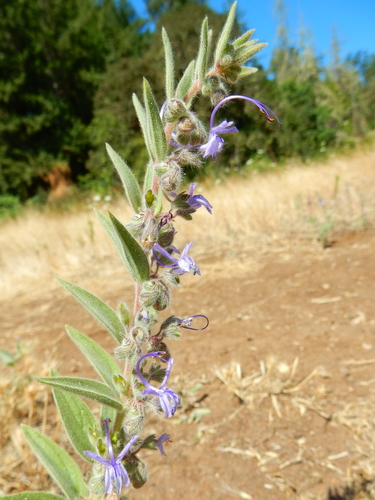


Vinegar Weed
trichostema lanceolatum
Vinegar Weed (Trichostema lanceolatum) is a fascinating annual herb native to the dry hills, grasslands, and chaparral of western North America, most notably California. This resilient plant is renowned for blooming in the late summer and autumn when most other annual vegetation has withered under the intense heat. It plays a critical ecological role as a vital late-season nectar source for native bumblebees, carpenter bees, and other pollinators, ensuring their survival before the winter months. The most defining characteristic of Vinegar Weed is its intensely pungent, vinegar-like aroma, which is emitted from sticky glandular hairs covering its leaves and stems. This powerful scent acts as a natural deterrent against grazing herbivores, protecting the plant during its peak flowering season. Historically, various Indigenous groups utilized the plant for its medicinal properties, brewing it into teas to soothe colds, reduce fevers, and alleviate physical pain.
Lebensraum: Found in dry, open grasslands, chaparral, and foothills, often thriving in sandy or clay soils baked by the summer sun.
Vinegar Weed typically grows as an erect, branching herb ranging from 10 to 90 centimeters in height. Its lance-shaped, grayish-green leaves are covered in soft, sticky, glandular hairs that produce its signature volatile oils. The flowers are pale blue to purple, clustered closely in the upper leaf axils. The most striking visual feature of the flower is its dramatically long, arching stamens that curve gracefully outward and downward, resembling delicate blue hairs designed to interact precisely with visiting insect pollinators.
Kategorie
PflanzenSeltenheit
Common
Gefahr
1/5 · Sehr gering
Snaps
Mach den ersten Snap!
Indigenous tribes, such as the Kawaiisu and Ohlone, traditionally used vinegar weed leaf infusions to treat headaches, colds, and stomach aches.
Its genus name, Trichostema, translates from Greek as 'hair-like stamens', a direct reference to the plant's elegant floral anatomy.
The plant's intense vinegar aroma is caused by volatile oils that evaporate in the summer heat, creating an invisible chemical shield.
Produces strong volatile oils, including camphor and cineole, which emit a powerful vinegar scent to deter grazing herbivores.
Thrives and blooms in the scorching heat of late summer and autumn when most other annual plants have already died.
Utilizes extremely long, curved stamens that act like a mechanical spring to deposit pollen precisely on the backs of foraging bees.
As a photosynthetic plant, Vinegar Weed produces its own energy using sunlight, carbon dioxide, water, and soil minerals.
Xylocopa sonorina
Pollinated by this large native bee, which is strong enough to trigger the plant's arching stamens.
Bombus vosnesenskii
Relies on this common native bumblebee for late-season pollination in dry chaparral habitats.
Apis mellifera
Competes with native bee species for the abundant late-season nectar produced by Vinegar Weed flowers.
Für dieses Objekt sind noch keine Merkmal-Badges vergeben.
Noch keine Alternativnamen vorhanden.
Sammlungen für dieses Objekt erscheinen hier, wenn weitere Themen hinzugefügt werden.
Gefahr
1/5 · Sehr gering
Noch keine besonderen Sicherheitshinweise.
Der einfachste Weg, Vinegar Weed zu bestimmen, ist die Verwendung der Naturführer-App Snappit.
10-90 cm
1 Jahre
As a photosynthetic plant, Vinegar Weed produces its own energy using sunlight, carbon dioxide, water, and soil minerals.
Found in dry, open grasslands, chaparral, and foothills, often thriving in sandy or clay soils baked by the summer sun.
Zoome hinein, um Cluster aufzulösen und zu sehen, wo dieses Objekt fotografiert wurde.
Neueste Snaps erscheinen hier, wenn neue Beobachtungen hinzukommen.
















