

Virginia Heartleaf
asarum virginicum
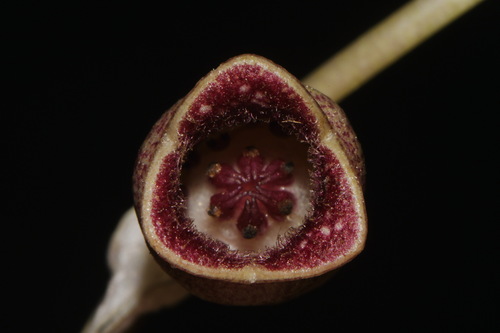
The Virginia Heartleaf (Asarum virginicum) is a charming, low-growing evergreen perennial native to the rich, acidic woodlands of the southeastern United States. Carpeted across the forest floor, its beautifully mottled, heart-shaped leaves provide year-round visual interest. This subtle woodland gem belongs to the birthwort family and is closely related to wild ginger. It is famous for its curious, flask-shaped flowers, which are often affectionately called "little brown jugs." Because these unique flowers bloom at ground level hidden beneath a dense blanket of leaf litter, they are rarely seen by casual passersby. They rely on ground-dwelling insects, such as beetles and ants, for pollination and seed dispersal. For native plant enthusiasts, stumbling upon a patch of Virginia Heartleaf is a delightful reward during a quiet woodland hike, offering a glimpse into the intricate, hidden beauty of the forest floor ecosystem.
Lebensraum: Found in rich, acidic deciduous and mixed pine-hardwood forests, often nestled on damp slopes, ravines, and moist sandy soils.
Virginia Heartleaf is easily recognized by its glossy, leathery, heart-shaped leaves that grow in low-lying clumps up to 15 cm tall. The leaves feature a striking dark green background intricately marbled with silver-grey or pale green veining, which remains vibrant throughout the winter. Its unusual, fleshy flowers are brownish-purple, urn-shaped, and measure about 1.5 to 2.5 cm long. These flowers grow singularly at the very base of the leaf stems, often partially buried or obscured by fallen leaves, looking like miniature, leathery jugs resting on the soil.
Kategorie
PflanzenSeltenheit
Common
Gefahr
1/5 · Sehr gering
Snaps
Mach den ersten Snap!
Crushing the evergreen leaves releases a distinct, spicy ginger-like aroma, which is why members of this genus are often referred to as wild gingers.
Its seeds are dispersed via 'myrmecochory', which is a specialized cooperative relationship where ants act as the plant's personal gardeners.
The plant's flowers are commonly called 'little brown jugs' because their shape and color closely resemble old-fashioned earthenware jugs.
The flowers grow directly at the soil surface under leaf litter, protecting them from harsh weather and aligning perfectly with ground-crawling pollinators.
Seeds possess lipid-rich appendages called elaiosomes that entice ants to carry them to their underground nests, ensuring safe seed dispersal and planting.
The thick, leathery leaves contain specialized compounds that prevent freezing damage, allowing the plant to photosynthesize year-round in temperate winters.
As a photosynthetic plant, it synthesizes its own food using sunlight, water, and carbon dioxide, supplemented by nutrients absorbed from rich, acidic woodland soils.
Camponotus pennsylvanicus
Ants carry the seeds back to their nests to feed on the nutritious elaiosome, effectively dispersing and planting the seeds.
Battus philenor
The caterpillar larvae of this butterfly feed on the foliage of birthworts, including wild ginger species.
Deroceras reticulatum
Slugs feed on the low-lying foliage and succulent ground flowers of this species.
Für dieses Objekt sind noch keine Merkmal-Badges vergeben.
Noch keine Alternativnamen vorhanden.
Sammlungen für dieses Objekt erscheinen hier, wenn weitere Themen hinzugefügt werden.
Gefahr
1/5 · Sehr gering
Noch keine besonderen Sicherheitshinweise.
Der einfachste Weg, Virginia Heartleaf zu bestimmen, ist die Verwendung der Naturführer-App Snappit.
8+ cm
5+ Jahre
As a photosynthetic plant, it synthesizes its own food using sunlight, water, and carbon dioxide, supplemented by nutrients absorbed from rich, acidic woodland soils.
Found in rich, acidic deciduous and mixed pine-hardwood forests, often nestled on damp slopes, ravines, and moist sandy soils.
10+
Zoome hinein, um Cluster aufzulösen und zu sehen, wo dieses Objekt fotografiert wurde.
Neueste Snaps erscheinen hier, wenn neue Beobachtungen hinzukommen.












_-_Flickr_-_brewbooks.jpg&width=800)