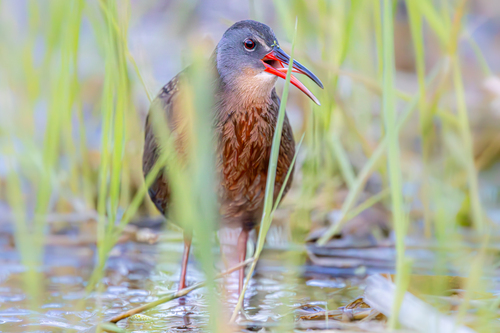


Virginia Rail
rallus limicola
The Virginia Rail is a small, highly secretive waterbird of the Rallidae family, renowned for its ability to navigate through dense marsh vegetation with ease. While rarely seen, this chicken-like bird is frequently heard, producing a variety of grunting, clicking, and metallic calls echoing from the reeds. It possesses a uniquely compressed body structure and strong legs, allowing it to squeeze through tight spaces where larger animals would struggle. Despite its preference for running through undergrowth rather than flying, it is a fully capable migrant that travels vast distances under the cover of night.
Lebensraum: Typically found in dense freshwater and brackish marshes dominated by emergent vegetation like cattails, bulrushes, and sedges.
The Virginia Rail is a compact, short-tailed bird measuring roughly 20 to 27 centimeters in length. It features a bright, warm-rusty breast and neck, which contrasts sharply with its blue-gray cheeks and a dark-streaked brown back. Its most prominent features are its long, slightly decurved reddish bill and the striking black-and-white vertical barring on its flanks. Its legs are reddish-brown and end in long, slender toes adapted for walking on soft mud without sinking.
Kategorie
VögelSeltenheit
Common
Gefahr
1/5 · Sehr gering
Snaps
Mach den ersten Snap!
Despite their reluctance to fly during the day, they perform long-distance migrations at night, sometimes colliding with urban structures because they fly low.
The muscles in their legs are so highly developed that they make up nearly 15% of their total body weight, an adaptation for a life of running and climbing.
To prevent wear and tear from constantly pushing through abrasive marsh vegetation, the Virginia Rail has modified, stiffened feathers on its forehead.
Their bodies are laterally compressed, meaning they are narrower than they are wide, which allows them to easily slip through dense, stiff marsh reeds without rustling the vegetation.
The tip of their long bill is highly sensitive and flexible, allowing them to locate and capture tiny invertebrates buried deep in the mud by feel alone.
If their nest is threatened, parents can carry their small chicks one by one in their bills to a safer location within the marsh.
Feeds primarily on a wide variety of aquatic invertebrates, small fish, and frogs, supplemented by seeds and wetland plants during the winter months.
Altersunterschiede: Chicks are fed almost exclusively on high-protein insects and larvae by their parents, transitioning to seeds and larger invertebrates as they mature.
Circus hudsonius
Virginia Rails are preyed upon by this large bird of prey, which regularly patrols marshes searching for small animals in the reeds.
Pacifastacus leniusculus
This crustacean is a highly favored prey item, hunted by the rail probing into muddy shallows.
Porzana carolina
Often shares the same marsh habitat, competing for similar insect prey and nesting territory.
Für dieses Objekt sind noch keine Merkmal-Badges vergeben.
Noch keine Alternativnamen vorhanden.
Sammlungen für dieses Objekt erscheinen hier, wenn weitere Themen hinzugefügt werden.
Gefahr
1/5 · Sehr gering
Noch keine besonderen Sicherheitshinweise.
Der einfachste Weg, Virginia Rail zu bestimmen, ist die Verwendung der Naturführer-App Snappit.
20+ cm
32+ cm
0.06+ kg
1+ Jahre
30 km/h
Feeds primarily on a wide variety of aquatic invertebrates, small fish, and frogs, supplemented by seeds and wetland plants during the winter months.
Typically found in dense freshwater and brackish marshes dominated by emergent vegetation like cattails, bulrushes, and sedges.
Zoome hinein, um Cluster aufzulösen und zu sehen, wo dieses Objekt fotografiert wurde.
Neueste Snaps erscheinen hier, wenn neue Beobachtungen hinzukommen.



















