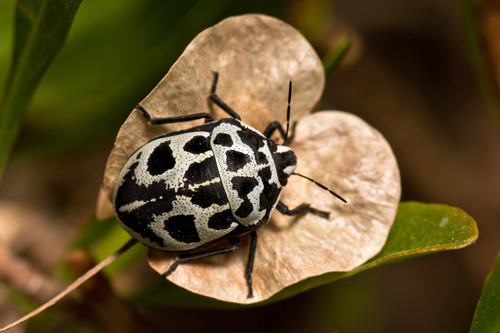


Voodoo Shieldbugs
deroplax
The Voodoo Shieldbugs, belonging to the genus Deroplax, are fascinating members of the Scutelleridae family, often recognized by their distinctive, elongated scutellum that covers most of their abdomen, giving them a shield-like appearance. These true bugs are a captivating example of insect diversity within tropical and subtropical ecosystems, primarily in Africa. Their unique morphology provides both camouflage and defense, allowing them to blend seamlessly with their plant hosts while deterring potential predators. They play an important ecological role as primary consumers, influencing plant health and serving as a food source for other arthropods and insectivores. Studying Voodoo Shieldbugs offers insights into herbivore-plant interactions and the intricate balance of their specific habitats.
Lebensraum: Found predominantly in tropical and subtropical regions of Africa, Voodoo Shieldbugs inhabit areas rich in vegetation, including forests, woodlands, savannas, and cultivated fields, where they feed on various host plants.
Voodoo Shieldbugs typically exhibit a broad, oval, and somewhat flattened body shape, dominated by an enlarged, often metallic or vibrantly colored scutellum that extends almost to the end of the abdomen, completely covering the wings. Their coloration varies but commonly includes cryptic shades of green, brown, or grey, often with iridescent sheens, black markings, or sometimes striking red or orange patterns, aiding in camouflage among foliage. They possess a small head, robust legs, and piercing-sucking mouthparts, with adults ranging from approximately 1 to 2.5 centimeters in length. The antennae are usually segmented and relatively short.
Kategorie
InsektenSeltenheit
Common
Gefahr
1/5 · Sehr gering
Snaps
Mach den ersten Snap!
Some shield bug species, though not specifically confirmed for Deroplax, exhibit a degree of maternal care, guarding their eggs and newly hatched nymphs against predators.
The genus name 'Deroplax' refers to the 'shield' or 'plate' characteristic of these bugs, highlighting their most striking feature.
Unlike many insects with visible wings, the Voodoo Shieldbug's wings are almost entirely concealed by its enlarged, helmet-like scutellum, giving it a distinctive 'solid-bodied' appearance.
Their most defining feature, the enlarged scutellum, acts as a hardened shield, providing excellent physical protection against predators and mechanical damage. This structure is a key adaptation for survival.
Like many true bugs, Voodoo Shieldbugs possess scent glands that release foul-smelling chemical compounds when threatened. This noxious odor serves as an effective deterrent against birds, lizards, and other predators.
Their often cryptic coloration and body shape allow them to blend seamlessly with their host plants, mimicking leaves, bark, or seeds. This enables them to avoid detection by predators while feeding.
Voodoo Shieldbugs are phytophagous, meaning they primarily feed on plant sap. They use their piercing-sucking mouthparts to extract fluids from various parts of their host plants.
Altersunterschiede: Nymphs (immature stages) have a similar diet to adults, feeding on the same host plants and extracting sap.
Aves
Adults and nymphs are prey for various generalist predators in their ecosystem.
Scelionidae
Parasitic wasps lay eggs on Voodoo Shieldbug eggs, controlling their populations.
Plantae
Voodoo Shieldbugs feed on the sap of various plants.
Für dieses Objekt sind noch keine Merkmal-Badges vergeben.
Noch keine Alternativnamen vorhanden.
Sammlungen für dieses Objekt erscheinen hier, wenn weitere Themen hinzugefügt werden.
Gefahr
1/5 · Sehr gering
Noch keine besonderen Sicherheitshinweise.
Der einfachste Weg, Voodoo Shieldbugs zu bestimmen, ist die Verwendung der Naturführer-App Snappit.
1-2 cm
2-4 cm
0.001-0.005 kg
0-1 Jahre
Voodoo Shieldbugs are phytophagous, meaning they primarily feed on plant sap. They use their piercing-sucking mouthparts to extract fluids from various parts of their host plants.
Found predominantly in tropical and subtropical regions of Africa, Voodoo Shieldbugs inhabit areas rich in vegetation, including forests, woodlands, savannas, and cultivated fields, where they feed on various host plants.
Foraging
Zoome hinein, um Cluster aufzulösen und zu sehen, wo dieses Objekt fotografiert wurde.
Neueste Snaps erscheinen hier, wenn neue Beobachtungen hinzukommen.

















