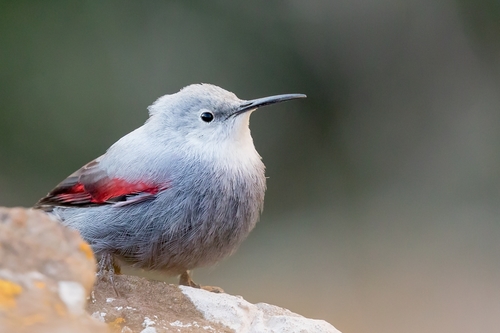


Wallcreeper
tichodroma muraria
The Wallcreeper, Tichodroma muraria, is a unique and captivating passerine bird renowned for its extraordinary climbing abilities and striking plumage. Often described as a "butterfly among birds" due to its broad, crimson-patched wings, it navigates sheer rock faces with the agility of a spider. This elusive avian gem inhabits remote mountainous regions, where it meticulously probes crevices for insects, a testament to its specialized lifestyle. Its solitary nature and specialized niche make it a sought-after species for birdwatchers and naturalists, embodying the spirit of the untamed high-altitude wilderness.
Lebensraum: Found in high-altitude mountainous regions, typically on steep rock faces, cliffs, gorges, and rocky ravines, often above the treeline.
The Wallcreeper is a small, striking bird, approximately 15-17 cm in length, with a predominantly slate-grey body. Its most distinctive features are the large, rounded wings which reveal brilliant crimson patches, especially prominent in flight or when fanned. It has a long, slender, slightly downcurved black bill perfectly adapted for probing. Its tail is short, and its black feet with strong claws are clearly visible, aiding its vertical locomotion.
Kategorie
VögelSeltenheit
Common
Gefahr
1/5 · Sehr gering
Snaps
Mach den ersten Snap!
During winter, Wallcreepers often descend from high alpine zones to lower altitudes, sometimes even visiting quarries, castles, or church towers, making them slightly easier to spot.
Known as the "butterfly bird" because of its strikingly colored, rounded wings that flash crimson patches, especially visible during flight or display.
The Wallcreeper is the sole member of its family, Tichodromidae, highlighting its unique evolutionary path and specialized adaptations.
Unlike typical tree-climbing birds like woodpeckers, the Wallcreeper uses its strong legs and claws to climb with a jerky, mouse-like movement, not relying on its tail for support.
The Wallcreeper possesses exceptionally strong feet and long, sharp claws, allowing it to cling and ascend vertical rock surfaces with remarkable agility, often appearing to defy gravity without the aid of its tail.
Its long, slender, slightly decurved bill is perfectly adapted for probing deep into narrow rock crevices, extracting insects and spiders that are inaccessible to most other birds.
While its grey plumage provides excellent camouflage against rock, the vivid crimson patches on its wings can be flashed during territorial displays, courtship rituals, or possibly to startle potential predators.
The Wallcreeper's diet consists almost exclusively of invertebrates, which it meticulously extracts from rock crevices and surfaces. It is a specialized forager of insects and spiders.
Segestria florentina
Preys upon various insects found in rock crevices.
Trichoptera larvae
Eats various insect larvae found on rock faces.
Falco peregrinus
Potential aerial predator of fledglings or less agile adults.
Pyrrhocorax graculus
Shares cliff habitat and competes for nesting sites and food resources, though dietary overlap may be limited.
Für dieses Objekt sind noch keine Merkmal-Badges vergeben.
Noch keine Alternativnamen vorhanden.
Sammlungen für dieses Objekt erscheinen hier, wenn weitere Themen hinzugefügt werden.
Gefahr
1/5 · Sehr gering
Noch keine besonderen Sicherheitshinweise.
Der einfachste Weg, Wallcreeper zu bestimmen, ist die Verwendung der Naturführer-App Snappit.
15-17 cm
27-32 cm
0.016-0.022 kg
8-10 Jahre
40 km/h
The Wallcreeper's diet consists almost exclusively of invertebrates, which it meticulously extracts from rock crevices and surfaces. It is a specialized forager of insects and spiders.
Found in high-altitude mountainous regions, typically on steep rock faces, cliffs, gorges, and rocky ravines, often above the treeline.
Zoome hinein, um Cluster aufzulösen und zu sehen, wo dieses Objekt fotografiert wurde.
Neueste Snaps erscheinen hier, wenn neue Beobachtungen hinzukommen.

















