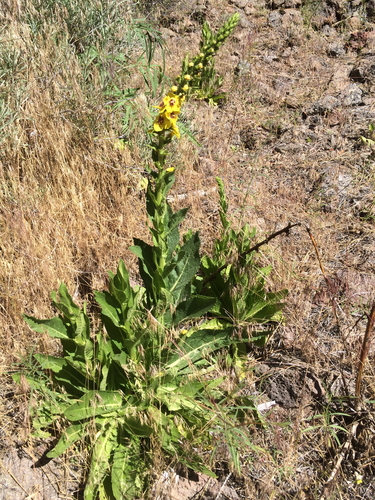


Wand Mullein
verbascum virgatum
Wand Mullein is an upright, resilient biennial herb from the figwort family, Scrophulariaceae. During its first year of growth, it forms a tight, ground-hugging rosette of crinkled green leaves. In its second year, it shoots up a single, dramatic floral wand that can reach up to two meters high, studded with beautiful yellow flowers. Native to southwestern Europe, this highly adaptable pioneer plant has successfully naturalized in temperate zones around the globe, where it thrives in sunny, dry, and highly disturbed soils.
Lebensraum: Found in disturbed soils, roadsides, pastures, gravel pits, and dry waste fields.
The plant is easily recognized by its tall, upright, mostly unbranched stem measuring 100 to 200 centimeters tall. Its leaves are dark green, slightly glossy, lance-shaped, and feature double-toothed margins that become smaller as they climb the stem. The flowers, about 3 to 4 centimeters in diameter, consist of five bright yellow petals surrounding a striking cluster of stamens heavily covered in distinct purple or violet-colored hairs.
Kategorie
PflanzenSeltenheit
Common
Gefahr
1/5 · Sehr gering
Snaps
Mach den ersten Snap!
Its species name 'virgatum' is derived from Latin and means 'wand-like' or 'twiggy', referencing its tall, straight growth form.
The dried, rigid flower stalks of Wand Mullein were once dipped in tallow or wax to serve as torches, earning them the nickname 'witches' candles'.
The seeds contain compounds called saponins, which were historically used by indigenous communities to stun fish in slow-moving water.
Produces seeds that can remain dormant and completely viable in the soil seed bank for over a century, germinating only when the ground is disturbed.
Develops a deep, sturdy taproot that extracts water from deep underground layers, allowing the plant to survive in arid, nutrient-poor conditions.
The stem and floral bracts are covered in sticky, glandular hairs that deter crawling predatory insects from damaging the flowers.
Uses chlorophyll to capture sunlight, combining it with carbon dioxide and water to produce vital sugars through photosynthesis.
Apis mellifera
Visits the open yellow flowers to collect nectar and pollen, acting as a primary pollinator.
Cucullia verbasci
The caterpillars of this moth feed heavily on the large, soft leaves of the mullein plant.
Carduelis carduelis
Feeds on the tiny seeds contained within the dried capsules during the autumn and winter months.
Für dieses Objekt sind noch keine Merkmal-Badges vergeben.
Noch keine Alternativnamen vorhanden.
Sammlungen für dieses Objekt erscheinen hier, wenn weitere Themen hinzugefügt werden.
Gefahr
1/5 · Sehr gering
Noch keine besonderen Sicherheitshinweise.
Der einfachste Weg, Wand Mullein zu bestimmen, ist die Verwendung der Naturführer-App Snappit.
100+ cm
1+ Jahre
Uses chlorophyll to capture sunlight, combining it with carbon dioxide and water to produce vital sugars through photosynthesis.
Found in disturbed soils, roadsides, pastures, gravel pits, and dry waste fields.
Zoome hinein, um Cluster aufzulösen und zu sehen, wo dieses Objekt fotografiert wurde.
Neueste Snaps erscheinen hier, wenn neue Beobachtungen hinzukommen.