

Waterlily Leafcutter Moth
elophila obliteralis
The Waterlily Leafcutter Moth (Elophila obliteralis) is a fascinating aquatic insect renowned for its unique larval stage. Unlike most moths, its caterpillars live underwater, constructing portable cases from pieces of waterlily leaves. This adaptation allows them to feed directly on the submerged and floating leaves of various aquatic plants, making them an intriguing component of freshwater ecosystems. The adult moths, while short-lived, are nocturnal and typically seen fluttering near the water's surface, completing a remarkable life cycle that bridges both aquatic and aerial environments. Their specialized lifestyle highlights the incredible diversity and adaptability found within the insect world, particularly among the Lepidoptera.
Lebensraum: Found in calm freshwater environments such as ponds, lakes, slow-moving streams, and ditches rich in aquatic vegetation like waterlilies and pondweeds.
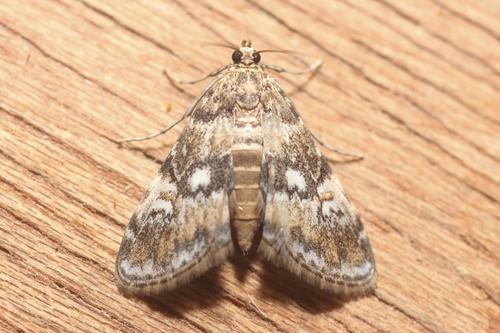
The adult Waterlily Leafcutter Moth is a small moth, with a wingspan typically ranging from 1.5 to 2.5 centimeters. Its forewings are predominantly white or cream-colored, often marked with light brown, tan, or golden-yellow patterns, including wavy lines and darker spots that can vary in intensity. The hindwings are generally lighter. When at rest, the wings are held in a triangular shape over its body. The larvae are small, pale green caterpillars that reside within distinctive, silken cases made from circular or oval pieces of host plant leaves, which they carry as they feed.
Kategorie
InsektenSeltenheit
Common
Gefahr
1/5 · Sehr gering
Snaps
Mach den ersten Snap!
Pupation for this moth also occurs underwater; the larva attaches its leaf case to the host plant and forms a silken cocoon within, from which the adult moth later emerges and floats to the surface.
The larvae cut out circular pieces of waterlily leaves to create a portable, protective case that they live inside, moving it around as they feed.
Unlike most caterpillars, the larvae of the Waterlily Leafcutter Moth possess specialized gills, allowing them to breathe and develop entirely underwater.
While generally native to North America, Elophila obliteralis has been introduced to parts of Europe, where it can sometimes become a minor pest in ornamental water gardens due to its feeding habits on waterlilies.
Larvae expertly cut sections from host plant leaves and bind them with silk to create a portable, protective case, which they inhabit throughout their underwater development.
The larval stage possesses specialized tracheal gills that enable it to breathe efficiently underwater, allowing for extended periods of submerged feeding and development.
The caterpillars are adapted to feed directly on the submerged and floating leaves of aquatic plants, chewing through the plant tissue while remaining protected within their cases.
The larvae of the Waterlily Leafcutter Moth are herbivorous, feeding exclusively on the leaves of various aquatic plants. Adult moths either do not feed or consume only small amounts of nectar.
Altersunterschiede: Larvae consume aquatic plant leaves; adults are non-feeding or minimally feed on nectar for energy.
Nymphaea alba
Primary food source and host plant for larvae.
Micropterus salmoides
Larvae and pupae are preyed upon by various fish species.
Anax junius
Larvae and pupae are consumed by predatory aquatic insect larvae.
Anas platyrhynchos
Larvae and pupae can be eaten by various waterfowl.
Für dieses Objekt sind noch keine Merkmal-Badges vergeben.
Noch keine Alternativnamen vorhanden.
Sammlungen für dieses Objekt erscheinen hier, wenn weitere Themen hinzugefügt werden.
Gefahr
1/5 · Sehr gering
Noch keine besonderen Sicherheitshinweise.
Der einfachste Weg, Waterlily Leafcutter Moth zu bestimmen, ist die Verwendung der Naturführer-App Snappit.
0-1 cm
1-2 cm
0.0001-0.0002 kg
0 Jahre
The larvae of the Waterlily Leafcutter Moth are herbivorous, feeding exclusively on the leaves of various aquatic plants. Adult moths either do not feed or consume only small amounts of nectar.
Found in calm freshwater environments such as ponds, lakes, slow-moving streams, and ditches rich in aquatic vegetation like waterlilies and pondweeds.
Grazing
Zoome hinein, um Cluster aufzulösen und zu sehen, wo dieses Objekt fotografiert wurde.
Neueste Snaps erscheinen hier, wenn neue Beobachtungen hinzukommen.