






Wattled Crane
Bugeranus carunculatus
The Wattled Crane is a tall, elegant bird with long legs and a unique wattle on its face. It loves to live in wetlands and is known for its beautiful dance during courtship.
Lebensraum: Wetlands
The Wattled Crane is a tall, elegant bird with a mainly grey body, a white neck and crown, and a distinctive black face. Its most notable features are the two pendulous, fleshy wattles, bright red in colour, that hang below its chin, covered in small white feathers.
Kategorie
VögelSeltenheit
Rare
Gefahr
1/5 · Sehr gering
Snaps
Mach den ersten Snap!
A Wattled Crane chick sometimes gets special help from both parents!
Their loud, rattling calls can be heard echoing across vast distances!
They use their long bills to dig up tasty tubers hidden underground!
Wattled Cranes are the largest crane species found on the African continent!
Wattled Cranes have prominent, fleshy wattles that help them communicate mood and health, especially during important courtship rituals.
Wattled Cranes can navigate deep, flooded wetlands because of their exceptionally long legs, which helps them forage for food safely.
Wattled Cranes have broad, powerful wings that help them soar high in the sky, allowing them to spot distant threats or food sources.
Wattled Cranes can construct large nests on floating vegetation because it provides a safe, elevated platform away from land predators.
These large birds are omnivores, eating wetland plants, seeds, insects, and small aquatic animals.
Polemaetus bellicosus
Martial Eagles sometimes prey on their eggs and young chicks.

Lycaon pictus
African Wild Dogs can sometimes eat eggs or unattended chicks.
Nymphaea nouchali
They eat rhizomes and tubers from wetland plants like this.
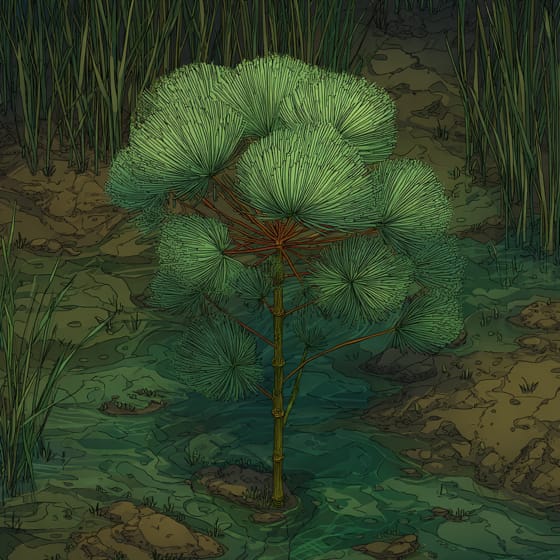
Cyperus papyrus
They rely on papyrus swamps for nesting and foraging grounds.
Gefiedert beschreibt Tiere, hauptsächlich Vögel, die ein Federkleid besitzen.
Soziale Tiere leben in organisierten Gruppen und kooperieren, um ihr Überleben zu sichern, beispielsweise bei der Nahrungssuche, Verteidigung und Aufzucht der Jungen.
Dieses Merkmal kennzeichnet Lebewesen, deren Ernährung vollständig oder hauptsächlich aus pflanzlichem Material besteht.
Dieses Lebensraummerkmal kennzeichnet Arten, die in Feuchtgebieten vorkommen. Dies sind Landflächen, die dauerhaft oder saisonal mit Wasser gesättigt sind, darunter Marschland, Sümpfe und Moore.

Tagaktive Tiere sind hauptsächlich bei Tageslicht aktiv und ruhen oder schlafen in der Regel nachts.

Wandertiere unternehmen saisonale Wanderungen von einer Region in eine andere, meist als Reaktion auf Klimaänderungen oder Nahrungsverfügbarkeit.

Der Status 'Stark gefährdet' bedeutet, dass eine Art in naher Zukunft einem sehr hohen Risiko ausgesetzt ist, in freier Wildbahn auszusterben.
Noch keine Alternativnamen vorhanden.
Gefahr
1/5 · Sehr gering
Always watch birds from a distance and do not try to touch them.
100-120 cm
180-230 cm
6.4-7.9 kg
20-30 Jahre
65 km/h
These large birds are omnivores, eating wetland plants, seeds, insects, and small aquatic animals.
Wetlands
Foraging
Zoome hinein, um Cluster aufzulösen und zu sehen, wo dieses Objekt fotografiert wurde.
Neueste Snaps erscheinen hier, wenn neue Beobachtungen hinzukommen.

Florida, US
Hier kann man sehen Komodowaran, Giraffen und Bonobo.
Führer anzeigen →

Texas, US
Hier kann man sehen Afrikanischer Löwe, Giraffen und Tiger.
Führer anzeigen →

Louisiana, US
Hier kann man sehen Ringed Teal, Kirk's Dik-Dik und Chinchilla Lanigera.
Führer anzeigen →








_male.jpg&width=800)







