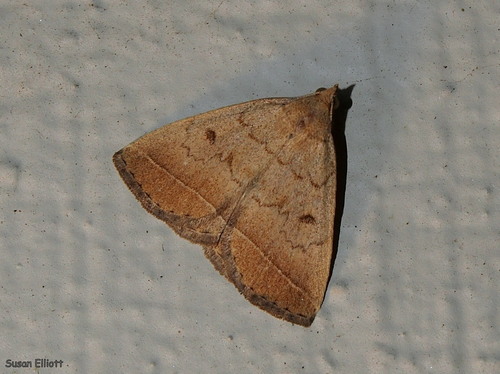


Wavy-Lined Fan-Foot
zanclognatha jacchusalis
The Wavy-Lined Fan-Foot (Zanclognatha jacchusalis) is a fascinating member of the litter moth subfamily within the family Erebidae. Native to North America, this nocturnal moth plays an incredibly important role in forest ecosystems. As caterpillars, they are dedicated detritivores, consuming fallen leaf litter, dead foliage, and decaying organic matter on the forest floor, which directly aids in nutrient recycling. Adults are recognized by their subtle but beautiful wing patterns, which perfectly mimic the dead leaves they rest upon during the day. This master of disguise blends seamlessly into the woodland floor, relying on its cryptically colored wings to evade predators while waiting for the cover of night to take flight.
Lebensraum: Typically found in moist deciduous woodlands, mixed forests, and brushy edge habitats where leaf litter is abundant.
This small moth features a wingspan of 2 to 4 centimeters. Its wings range in color from pale yellowish-tan to warm brown, adorned with distinct, dark, wavy transverse lines running across both the forewings and hindwings. A key diagnostic feature is the pair of long, prominently upturned labial palpi projecting forward from the head, resembling tiny snout-like structures. In males, the antennae are slightly comb-like and have a characteristic knot-like swelling in the middle.
Kategorie
InsektenSeltenheit
Common
Gefahr
1/5 · Sehr gering
Snaps
Mach den ersten Snap!
Adults can often be found during the day hiding under loose bark or among leaf litter, where their coloration makes them nearly invisible to predators.
The common name 'fan-foot' refers to the fan-like tufts of scales on the forelegs of males in this genus, used to disperse pheromones during courtship.
Unlike many caterpillar species that feed on fresh, green leaves, the Wavy-Lined Fan-Foot caterpillar prefers dry, brown, and decaying leaves from the forest floor.
The moth's coloration and wing shape allow it to blend flawlessly with dead leaves, protecting it from predators on the forest floor.
Males possess highly specialized antennae with sensory receptors designed to detect female pheromones over long distances at night.
As larvae, they possess unique gut enzymes that allow them to efficiently digest tough, low-nutrient dead leaves and decaying plant material.
Larvae feed primarily on dead and decaying leaves of various deciduous trees, while adults occasionally feed on tree sap or plant secretions.
Quercus alba
The caterpillar feeds extensively on the fallen, decaying leaves of this tree.
Acer saccharum
Provides essential leaf litter on the forest floor for larval sustenance.
Eptesicus fuscus
This nocturnal predator feeds on flying adult moths in the forest canopy.
Für dieses Objekt sind noch keine Merkmal-Badges vergeben.
Noch keine Alternativnamen vorhanden.
Sammlungen für dieses Objekt erscheinen hier, wenn weitere Themen hinzugefügt werden.
Gefahr
1/5 · Sehr gering
Noch keine besonderen Sicherheitshinweise.
Der einfachste Weg, Wavy-Lined Fan-Foot zu bestimmen, ist die Verwendung der Naturführer-App Snappit.
1+ cm
2+ cm
0.0001+ kg
1+ Jahre
Larvae feed primarily on dead and decaying leaves of various deciduous trees, while adults occasionally feed on tree sap or plant secretions.
Typically found in moist deciduous woodlands, mixed forests, and brushy edge habitats where leaf litter is abundant.
Foraging
Zoome hinein, um Cluster aufzulösen und zu sehen, wo dieses Objekt fotografiert wurde.
Neueste Snaps erscheinen hier, wenn neue Beobachtungen hinzukommen.














.jpg&width=800)



