

West Indian Lilac
miconia bicolor
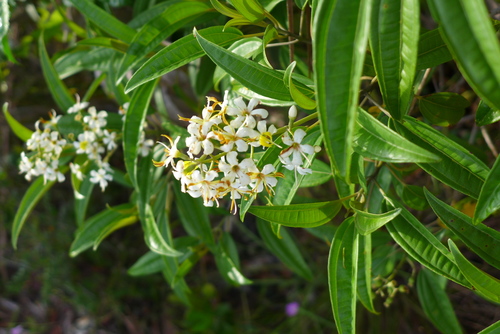
The West Indian Lilac (Miconia bicolor) is a striking evergreen shrub or small tree native to the lush, montane forests of the Caribbean. A member of the meadow beauty family (Melastomataceae), this plant is highly regarded for its aesthetic contrast and ecological role. It serves as a vital resource in its native ecosystem, producing abundant clusters of delicate white to pink flowers that give way to small, fleshy berries, providing a crucial food source for a variety of tropical birds and insects.
Lebensraum: Found in montane rainforests, wet limestone forests, and disturbed hillsides throughout the Caribbean islands.
Growing up to 2 to 5 meters tall, the West Indian Lilac is easily recognized by its remarkable lance-shaped leaves, which exhibit a distinct two-toned coloration. The upper leaf surface is a glossy, deep green, while the underside features a contrasting pale silvery, beige, or rusty-red hue. The leaves also display the characteristic melastome venation pattern, with three to five prominent veins curving symmetrically from the base to the leaf tip. It produces dense terminal clusters of tiny five-petaled white flowers followed by small, round berries that ripen from green to dark blue-black.
Kategorie
PflanzenSeltenheit
Common
Gefahr
1/5 · Sehr gering
Snaps
Mach den ersten Snap!
Its leaves show a dramatic two-tone coloration that shimmers in the wind, which is why it is often called 'bicolor'.
Like most members of the Melastomataceae family, its leaves feature a distinct grid-like vein pattern that looks like a ribcage.
The genus name Miconia honors the 16th-century Spanish physician and botanist Francisco Micón.
Possesses a specialized leaf vein structure that provides superior physical support and highly efficient water transport across the leaf blade.
The reflective, pale underside of its leaves helps deflect intense tropical sunlight and conserve moisture during dry spells.
Produces nutrient-dense berries designed to attract specific canopy birds, ensuring rapid and widespread seed dispersal.
As a photosynthetic plant, the West Indian Lilac manufactures its own sugars using sunlight, water, and carbon dioxide, aided by essential mineral nutrients absorbed from the soil.
Coereba flaveola
Feeds on the small blue-black berries of the plant and subsequently disperses the seeds through its droppings.
Swietenia mahagoni
Competes for canopy sunlight, root space, and soil moisture in Caribbean limestone forest habitats.
Myadestes genibarbis
Feeds on the ripe berries in high-elevation montane forests, acting as an important seed disperser.
Für dieses Objekt sind noch keine Merkmal-Badges vergeben.
Noch keine Alternativnamen vorhanden.
Sammlungen für dieses Objekt erscheinen hier, wenn weitere Themen hinzugefügt werden.
Gefahr
1/5 · Sehr gering
Noch keine besonderen Sicherheitshinweise.
Der einfachste Weg, West Indian Lilac zu bestimmen, ist die Verwendung der Naturführer-App Snappit.
200+ cm
10+ Jahre
As a photosynthetic plant, the West Indian Lilac manufactures its own sugars using sunlight, water, and carbon dioxide, aided by essential mineral nutrients absorbed from the soil.
Found in montane rainforests, wet limestone forests, and disturbed hillsides throughout the Caribbean islands.
Zoome hinein, um Cluster aufzulösen und zu sehen, wo dieses Objekt fotografiert wurde.
Neueste Snaps erscheinen hier, wenn neue Beobachtungen hinzukommen.











.jpg&width=800)